When Howard Schultz walked the cobblestone streets of Milan in 1983, he experienced an epiphany that would fundamentally reorder global retail. The Italian espresso bar was not merely a dispensary for dark roast caffeine; it was an extension of civic life. Patrons lingered at marble counters, baristas addressed regulars by name, and neighborhoods found their communal rhythm between the morning commute and the evening return home.
At that moment, the United States was caught between two stark social poles: the private domain of home (the “first place”) and the structured, demanding environment of work or school (the “second place”). Schultz recognized a gaping void in modern urban geography. Drawing on the framework introduced by sociologist Ray Oldenburg in his seminal 1989 work The Great Good Place, Schultz set out to turn Starbucks into America’s—and ultimately the world’s—definitive “Third Place.”
This strategic positioning elevated Starbucks from a regional bean roaster in Seattle into a multibillion-dollar cultural institution. Starbucks did not build its empire by competing on the commodity price of roasted beans; it monetized an emotional, physical, and sensory haven.
1. The Sociology of the Third Place: Ray Oldenburg’s Blueprint
To understand why Starbucks succeeded, one must examine the sociological dynamics Oldenburg identified as the bedrock of informal public life:
- Neutral Ground: A space where individuals can arrive, stay, and depart as they please, free from hosting duties, formal etiquette, or social obligations.
- The Leveler: Social and economic distinctions fade into the background. A corporate CEO and an undergraduate student share the same communal table and order from the same menu board.
- Conversation as the Primary Activity: The setting accommodates effortless social interaction—whether focused debate, passive people-watching, or brief banter with the staff.
- Accessibility and Accommodation: Long operating hours, welcoming door policies, and reliable geographic proximity within neighborhood clusters.
- The Regulars: A recurring cadre of familiar faces that anchor the venue’s warmth and neighborhood character.
- A Low Profile: The atmosphere remains comfortable and unpretentious rather than sterile or intimidating.
- Playful Mood: An environment defined by lightheartedness, respite, and psychological safety.
- A Home Away from Home: A distinct sense of psychological ownership and belonging without the domestic chores.
Starbucks commercialized these sociological pillars. By purchasing a single cup of coffee—or at times, merely walking through the front door—a patron gained legal and psychological tenancy of a climate-controlled, well-appointed semi-private living room.
2. Sensory Architecture: Designing an Emotional Anchor
Starbucks transformed interior architecture into an engine of brand loyalty. Every layout choice, texture, and acoustic level was engineered to encourage lingering.
Acoustic Curations
In traditional quick-service restaurants, hard fiberglass booths, harsh fluorescent lighting, and ambient clatter are deliberately calibrated to increase table turnover. Starbucks inverted this model. It dampened acoustic harshness with soft upholstery, acoustic ceiling tiles, and curated music playlists. Through its Hear Music acquisition and internal playlist curators, the company made jazz, indie folk, and acoustic soul an atmospheric signature—so distinct that Starbucks eventually sold millions of CDs right next to the cash register.
Visual and Material Warmth
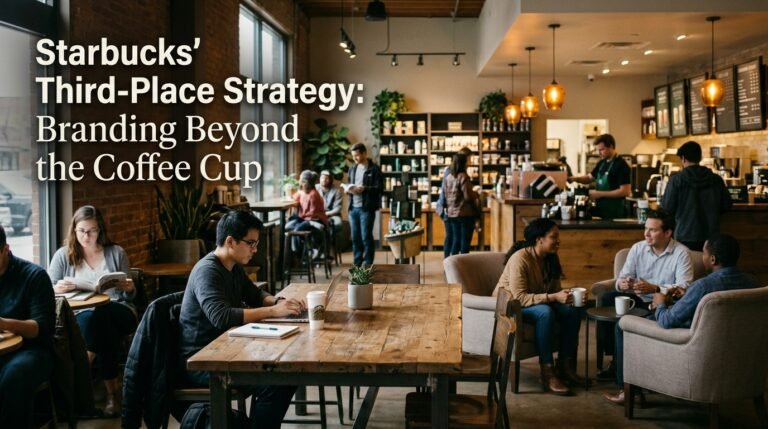
Stores incorporated natural wood grains, warm earth tones, exposed brick, and low-kelvin ambient lighting. Seating was arranged in deliberate clusters: high-top stools for quick contemplation, communal oak tables for collaborative study, and deep, low-slung armchairs that invited hours of deep reading.
Olfactory and Tactile Integrity
Schultz famously instituted strict rules barring employees from wearing perfume or cologne and banned smoking in stores long before it was universally mandated. Store-baked foods were chosen specifically to avoid overpowering the roasted aroma of espresso beans. The tactile experience was equally considered: thick, textured paper cups insulated by corrugated sleeves, smooth ceramic mugs for “for-here” orders, and the heat of the counter where drinks were handed over.
3. The Barista as Cultural Host and “Theater of the Cup”
In pure commodity retail, efficiency means reducing friction and automating human touchpoints. Starbucks recognized that if coffee was a commodity, the human relationship around its preparation was the value add.
[Raw Ingredient] ──► [Barista Craft & Theater] ──► [Personalized Name Call] ──► [Affirmed Identity]
The prep bar was consciously staged as an open performance platform:
- The Language of Italian Espresso: Ordering an Iced Venti Caramel Macchiato created a shared vernacular. Customers learned a specialized vocabulary that made them feel part of an initiated club.
- Customization as Micro-Agency: Custom milk selections, syrup pumps, and ice levels transformed the drink into an expression of individual identity.
- The Handwritten Cup: Writing the customer’s name on the cup bridged the gap between anonymous commercial transaction and personal recognition.
- The “Third Place” Host: Baristas were trained not just as fast-food line workers, but as neighborhood hosts, establishing daily micro-connections that anchored regular visits.
4. The Digital Evolution: Redefining Space in the Smartphone Era
As the internet restructured modern life, Starbucks recognized earlier than most that the definition of “place” was decoupling from physical geography.
The Wi-Fi Revolution (Early 2000s–2010s)
In an era when mobile data was scarce and coffee shops guarded passwords behind paid scratch-cards, Starbucks partnered with telecom providers to roll out seamless, free, high-speed Wi-Fi. This simple decision established Starbucks as the remote work capital of the world. It became the default office for freelance writers, startup founders, and students, permanently altering daytime retail foot traffic.
The App, Mobile Order & Pay, and the Friction Dilemma
Starbucks created one of the world’s most successful mobile ecosystems:
| Feature | Strategic Goal | Third-Place Impact |
| Starbucks Rewards | Drive repeat purchase frequency & build behavioral data | Increases brand stickiness; shifts engagement to digital screens |
| Mobile Order & Pay | Eliminate queue friction for high-velocity commuters | Congests pickup counters; can diminish casual barista conversation |
| Personalized Offers | Maximize customer lifetime value (LTV) | Reinforces individualized utility over shared physical community |
This digital transition introduced a major strategic tension. When morning rushes involve dozens of mobile orders lined up on a stainless-steel counter while delivery couriers and hurried professionals push past armchairs to grab their cups, the quiet, lingering oasis risks becoming a congested transit hub.
5. Strategic Challenges: When Efficiency Collides with Atmosphere
The Third-Place strategy is not immune to operational and economic realities. In recent years, Starbucks has confronted significant headwinds that challenge its foundational identity:
Store Format Divergence
To maximize throughput, Starbucks diversified away from the uniform living-room model:
- Pick-Up Only Stores: Compact, counter-less facilities built purely for mobile retrieval and app-driven couriers.
- Drive-Thru Domination: In suburban markets, drive-thrus now drive the majority of transactions, removing the physical interior from the customer journey altogether.
- The Reserve Roasteries: At the opposite end, ultra-luxurious, multi-story Roasteries serve as experiential brand cathedrals, separating high-end lifestyle leisure from everyday functional caffeine runs.
The Open Door Policy and Urban Realities
In 2018, following an incident involving the arrest of two non-purchasing men in a Philadelphia store, Starbucks officially established that anyone could sit in its spaces and use its restrooms without making a purchase. While this decision affirmed Oldenburg’s vision of a truly democratic, neutral public space, it presented operational challenges in dense urban centers, complicating staff safety and store cleanliness.
The Speed vs. Soul Dilemma
Cold beverages, customized modifiers (cold foams, plant-based milks, syrup blends), and app-driven velocity placed immense strain on store partners. When drinks take four minutes of complex chemistry to prepare, baristas have less bandwidth for the spontaneous, warm interactions that Schultz originally envisioned.
6. The Enduring Legacy of Experiential Commerce
Despite these challenges, Starbucks’ core strategic lesson remains one of the most powerful case studies in modern business history: Value is determined by context, not content.
A paper cup containing eight ounces of black drip coffee costs pennies in raw ingredients and sells for a modest sum at a street cart. When that same coffee is packaged inside a curated, climate-controlled, warmly lit sanctuary equipped with fast Wi-Fi, clean seating, comfortable acoustics, and a personalized greeting, customers willingly pay a 400% premium.
Commodity (Coffee Beans)
   └──► Product (Brewed Coffee)
         └──► Service (Barista Preparation)
               └──► Experience (The Third Place Environment)
By elevating its business from the commodity layer directly into the experience and transformation economy, Starbucks proved that the most durable brand loyalty is built not in the customer’s stomach, but in their sense of belonging. The “Third Place” gave millions of people a dependable anchor in an increasingly fragmented, transient world—a place where they could simply be.