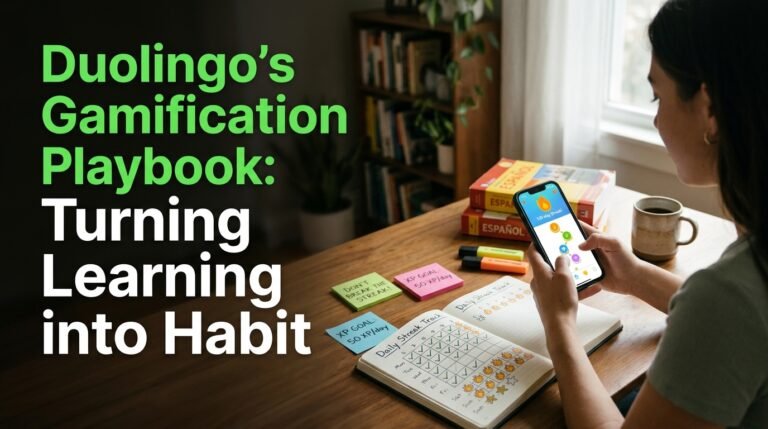
Language learning has traditionally carried a high barrier to entry: dense textbooks, expensive classroom sessions, rote conjugation drills, and an intimidating learning curve that produces an attrition rate well above 90%. Duolingo bypassed this friction not by rewriting the fundamentals of linguistics, but by restructuring how humans interact with digital products.
Instead of treating language education as an academic discipline, Duolingo treats it as a consumer engagement engine. By merging behavioral economics, variable reward schedules, and mobile UX design, the platform built a self-sustaining retention loop. Millions of users do not log in daily because they suddenly developed unbreakable self-discipline; they log in because Duolingo turned language practice into an engineered habit.
1. The Core Behavioral Loop: Cue, Routine, Reward
At the foundation of Duolingo’s retention strategy lies the classic habit loop popularized by behavioral psychology: Cue $\rightarrow$ Routine $\rightarrow$ Reward.
[Cue]                    [Routine]                 [Reward]
Push Notification  --->  3-Minute Bite-Sized  ---> XP, Animations,
/ Streak Warning         Micro-Lesson              Streak Counter Increment
- The Cue: Timed push notifications, widget updates, and visual urgency (e.g., an animated owl looking distressed).
- The Routine: Micro-lessons structured into three- to five-minute segments. By stripping away cognitive dread, the action feels friction-free: “I can spare three minutes on the train.”
- The Reward: Immediate sensory and numerical payoff—high-tempo chimes, haptic feedback, celebratory animations, experience points (XP), and the coveted advancement of the daily streak counter.
Over successive cycles, the external cue transitions into an internal cue. The user no longer needs an alert to open the app; an idle moment in line or before sleep triggers an automated impulse to maintain progress.
2. Loss Aversion: The Supremacy of the Streak
If XP is the currency of Duolingo, the Streak is its emotional collateral.
In behavioral economics, Daniel Kahneman and Amos Tversky’s prospect theory demonstrated that the psychological pain of losing something is approximately twice as intense as the joy of gaining the equivalent value. Duolingo leveraged this asymmetry by elevating the daily streak above all other metrics.
+--------------------------------------------------------------------+
|                      THE PSYCHOLOGICAL ESCALATION                  |
|                                                                    |
| Day 3:   "Neat, 3 days in a row."                                  |
| Day 30:  "I've built real momentum here."                         |
| Day 365: "I will do anything to avoid breaking this chain."        |
+--------------------------------------------------------------------+
A broken streak does not mean losing points; it means erasing an investment of identity. A user with a 450-day streak is rarely fighting for language fluency during a late-night session—they are defending their sunk cost.
To monetize and manage this psychological tension without driving churn, Duolingo introduced safety valves:
- Streak Freezes: A consumable item purchased with in-app currency (Gems/Lingots) that shields the streak if a day is missed. It provides agency while teaching users to monitor their buffer.
- Streak Repair: A monetized failsafe allowing lapsed users to restore a broken streak, either via premium subscription (Super Duolingo / Duolingo Max) or direct microtransactions.
By framing safety nets within loss aversion, Duolingo turns retention risks into monetization opportunities.
3. Social Proof and Competition: The League System
Intrinsic motivation (a desire to learn French or Japanese) fluctuates wildly. When internal willpower wanes, Duolingo substitutes extrinsic social pressure through its tiered League system.
Every week, users are pooled into 30-person cohorts competing across stratified divisions (Bronze, Silver, Gold, up through the Diamond League). The mechanics are borrowed straight from competitive multiplayer games:
| League Dynamic | Psychological Trigger | User Behavior |
| Top 7 Promotion Zone | Status seeking & achievement | Aggressive point-grinding early in the week to secure advancement. |
| Middle 16 Safe Zone | Baseline compliance | Minimum required daily output to avoid downward mobility. |
| Bottom 7 Demotion Zone | Fear of regression & embarrassment | High-urgency cramming on Sunday evenings to escape relegation. |
Crucially, Duolingo does not match casual users against global power-users. Matchmaking algorithms pair learners with peers showing comparable recent activity levels, ensuring the podium always feels within arm’s reach. This creates hyper-focused micro-competitions where five extra minutes can mean the difference between staying in Diamond or dropping to Obsidian.
4. Pacing and Friction: Micro-Progression Architecture
Traditional curricula overwhelm learners with comprehensive grammar rules upfront. Duolingo circumvents cognitive overload through strict scaffolding and chunking:
- Micro-Lessons: Tasks rarely demand open-ended essay writing. Instead, they use tap-to-complete word banks, audio transcription, matching pairs, and short voice prompts.
- The “One Path” Overhaul: Duolingo moved away from a broad, branching “tree” of choices to a linear learning path. Paradoxically, reducing choice increased completion rates. By removing decision fatigue, users never have to deliberate over what to study next—they simply tap the next pulsing node.
- Spaced Repetition Systems (SRS): Content naturally reintroduces past vocabulary just as retention decay begins. The system integrates review seamlessly into forward momentum, avoiding dedicated, tedious review sessions.
5. Re-Engagement Mastery: The Owl That Refuses to Be Ignored
Push notifications are often where consumer apps destroy their own goodwill through generic spam. Duolingo turned notification mechanics into a cultural touchpoint through Duo the Owl.
Instead of impersonal system announcements, Duolingo’s alerts adopt an anthropomorphic, mildly guilt-inducing tone:
“These reminders don’t seem to be working. We’ll stop sending them for now.”
This famous “breakup” notification is a calculated reverse-psychology play. By voluntarily yielding, it sparks instant FOMO (fear of missing out) and drives reactivation among lapsed users.
Furthermore, dynamic lock-screen widgets in modern mobile operating systems depict Duo evolving throughout the day: smiling in the morning, looking visibly fatigued in the afternoon, and melting into tears or glaring aggressively as midnight approaches. The notification is no longer static copy; it is a live tamagotchi-style pet demanding attention.
6. Friction as Monetization: The Hearts (Health) System
In free-to-play mobile gaming, artificial energy constraints are the primary lever for monetization. Duolingo adopted this via the Hearts System:
- Every error docks one heart out of five.
- Depleted hearts prevent users from starting new lessons.
- Hearts recharge slowly over time, through dedicated practice drills, or instantly via subscription.
[User Makes Mistake]
         │
         ▼
[Loses 1 Heart] ──► [0 Hearts Left?] ──No──► [Continue Lesson]
                           │
                          Yes
                           │
             ┌─────────────┴─────────────┐
             ▼                           ▼
     [Wait / Practice]           [Upgrade to Super]
     (Organic Churn Risk)       (Monetization Conversion)
While purists argue this penalizes the natural trial-and-error necessary for language acquisition, from a product design standpoint, it creates direct friction that drives high-intent users straight to premium tiers.
Strategic Lessons for Product Builders
Duolingo’s growth engine provides several actionable takeaways for product managers, UX designers, and founders across sectors:
- Quantify the Habit Early: Don’t wait for users to master your product before rewarding them. Reward the simple act of showing up on Day 1, Day 2, and Day 3.
- Design for Low-Energy States: An onboarding flow or daily core action that requires peak mental focus will fail on stressful days. Make the baseline routine so small that it is impossible to refuse.
- Turn Data into Emotional Stakes: Raw analytics (hours spent, pages read) rarely motivate. Transform usage data into stakes—streaks, status ranks, and streaks saved.
- Lean into Personality: Sterile enterprise messaging fails to penetrate notification fatigue. Give your product an identifiable, memorable voice that users can connect with.
By aligning behavioral psychology with iterative product design, Duolingo turned one of the hardest intellectual pursuits into a frictionless daily loop. It stands as clear proof that when you master habit loops, engagement takes care of itself.