In the late 2000s, the cloud storage market was crowded, commoditized, and plagued by high customer acquisition costs (CAC). Incumbents like Microsoft and Box competed fiercely against an array of early file-sync utilities. When Dropbox launched publicly in 2008, founders Drew Houston and Arash Ferdowsi encountered a brutal economic reality familiar to many early-stage SaaS ventures: traditional customer acquisition channels were fundamentally broken for their business model.
Paid search ads cost hundreds of dollars per conversion for a product priced at $9.99 a month. The arithmetic guaranteed bankruptcy.
Instead of raising larger venture rounds to subsidize unsustainable paid marketing, Dropbox pivoted to product-led growth (PLG) and viral engineering. Over a 15-month span between 2008 and 2010, Dropbox expanded from 100,000 registered users to over 4,000,000—a 3,900% increase—without running high-budget television spots, outbound sales teams, or expensive pay-per-click ad blitzes.
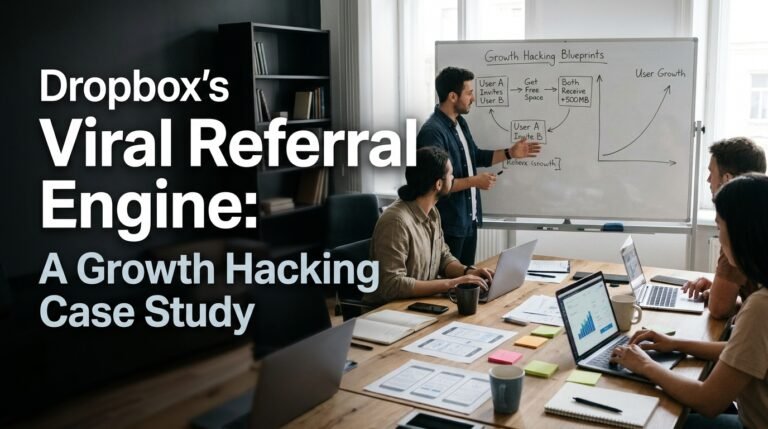
At the core of this expansion was an elegantly engineered, two-sided referral engine that turned everyday consumers into an unpaid distribution fleet.
1. The Broken Playbook: Why Traditional Marketing Failed
Before engineering their viral loop, Dropbox exhausted conventional enterprise and B2C acquisition playbooks:
- Google AdWords & Pay-Per-Click (PPC): Bidding on terms like “online storage” or “cloud backup” cost between $250 and $350 per paying customer. Because Dropbox charged $99/year (or offered a free tier), the payback period spanned multiple years, creating a massive cash flow deficit.
- Display Advertising: Banner ads failed because cloud storage in 2008 required behavioural education. Static banners could not convey why an invisible folder that synced across computers replaced USB flash drives.
- PR and Tech Press: TechCrunch spikes generated brief bursts of early adopters and tech enthusiasts, but churn was high and mainstream internet users remained untouched.
Dropbox realized that cloud storage was not a product people searched for proactively using intent-driven keywords. Users did not search for “seamless cross-device distributed file synchronization.” They dealt with broken email attachments, lost USB sticks, and crashed hard drives. Acquisition had to happen organically via personal recommendation and product experience.
2. Inspiration: Adapting PayPal’s Dual-Incentive Mechanism
Drew Houston and his team studied historic consumer referral programs, notably PayPal’s early incentive model. In the early 2000s, PayPal deposited $10 into both the referrer’s account and the referee’s account upon sign-up.
While financially effective for PayPal, direct cash incentives presented major liabilities for Dropbox:
- Cash Burn: Giving away fiat currency would rapidly deplete seed capital.
- Fraud and Sybil Attacks: Financial incentives attract bot farms, fake email rings, and professional bounty hunters looking to exploit cash payouts.
- Misaligned Value: Money does not incentivize engagement with the underlying product.
Dropbox translated the financial incentive into a functional, product-native currency: free storage space.
| Feature Attribute | PayPal Strategy | Dropbox Adaptation |
| Reward Medium | Hard currency ($10 cash) | Digital utility (500 MB permanent cloud storage) |
| Reward Structure | Two-sided (Sender & Receiver) | Two-sided (Sender & Receiver) |
| Marginal Cost | Fixed cash cost ($20 per pair) | Near-zero marginal cost (amortized server disk space) |
| Abuse Vulnerability | High (organized payout fraud) | Low (storage utility decays without actual product use) |
| Activation Impact | Neutral (users could withdraw cash) | Strong (users must upload files to realize value) |
3. Anatomy of the Engine: How the Referral Loop Worked
The mechanics of Dropbox’s referral program succeeded because every friction point in the user journey was systematically eliminated.
The Double-Sided Value Exchange
Most referral programs of the era were one-sided affiliate programs: “Tell your friends about us and get $5.” One-sided programs often make the sender feel self-conscious, as if they are commercially exploiting their personal relationships.
Dropbox eliminated this social friction through a two-sided reward:
- The Referrer received 500 MB of extra storage per successful invite (up to 16 GB).
- The Referee received an extra 500 MB on top of the standard 2 GB baseline quota.
The sender was no longer pitching a commercial product for personal benefit; they were gifting storage space to a friend or coworker.
Native Frictionless Invitations
Dropbox integrated invitation workflows directly into daily user pathways:
- One-Click Address Book Imports: Direct integration with Gmail, Yahoo! Mail, and AOL enabled users to import contacts and send customized invitations without manually copying email addresses.
- Unique Shareable URLs: Personalized referral links allowed sharing across Twitter, personal blogs, internet forums, and instant messaging clients (Skype, MSN Messenger).
- Desktop Notification Triggers: When an invited contact installed Dropbox, the referrer received a native desktop OS notification: “Your friend accepted your invite! You’ve earned 500 MB of bonus space.” This immediate positive reinforcement validated the effort and encouraged repeat sharing.
Transparent Status Dashboard
Referral abandonment often occurs when users feel their recommendations disappear into an administrative void. Dropbox resolved this by designing an unambiguous tracking dashboard displaying:
- Contact email addressed.
- Invitation status (Pending, Accepted, Ineligible).
- Space awarded to date.
Gamifying progress made achieving maximum free capacity (16 GB) an engaging challenge for digital power users.
4. The Mathematical Multiplier: Understanding K-Factor
In growth marketing, viral growth is governed by the viral coefficient, known as the K-factor:
$$K = I \times C$$
Where:
- $I$ = Number of invitations sent per active user.
- $C$ = Conversion rate of each invitation sent.
If $K > 1$, the customer base expands exponentially without paid acquisition. If $K < 1$, growth decelerates unless supplemented by baseline traffic.
Dropbox realized that even if an organic referral program does not achieve an autonomous $K > 1$ across every demographic cohort, pushing the viral coefficient to $0.7$ or $0.8$ produces an immense acquisition multiplier. For every 1,000 organic signups, an additional 700 to 800 users join through the secondary loop, cutting blended Customer Acquisition Cost (CAC) by 40% to 50%.
During its peak referral rollout, 35% of Dropbox’s daily signups came directly through the referral loop, permanently lowering customer acquisition costs and creating a defensible moat against well-funded enterprise competitors.
5. Strategic Takeaways for Modern SaaS & Product Leaders
The Dropbox referral engine remains a foundational case study in digital product design and growth marketing. Four enduring principles stand out for contemporary operators:
1. Currency Must Be Product-Native
Rewarding users with cash, gift cards, or discounts shifts the relationship from intrinsic utility to transactional extraction. By rewarding users with storage, Dropbox ensured that only users who genuinely needed and valued cloud storage engaged with the engine. Furthermore, users with more storage uploaded more data, drastically increasing switching costs and decreasing long-term churn.
2. Double-Sided Rewards Mitigate Social Debt
Whenever an acquisition mechanic relies on peer-to-peer distribution, eliminate the social awkwardness of the recommendation. Providing an equal or superior bonus to the recipient transforms the sender from a brand solicitor into a helpful peer providing utility.
3. Gamify Onboarding alongside Viral Distribution
Referrals were not the only growth mechanic Dropbox employed. They complemented the program with an onboarding checklist titled “Get Started.” Completing tasks like installing the mobile app, placing a file into the Dropbox folder, and connecting social profiles earned users incremental 250 MB bonuses. This guaranteed that users referred via the viral loop actually activated and reached the product’s “Aha!” moment.
4. Optimize the Friction of the Recipient’s First Mile
Referral links did not redirect incoming traffic to a bloated marketing home page. They routed directly to a streamlined signup form where the promise—“John gave you 500 MB of extra space”—was mirrored explicitly above the call to action. Friction was minimized until the client installer was running locally on the desktop.
Conclusion
Dropbox did not invent cloud storage, nor did it win the consumer market purely on technical superiority. It won because Drew Houston and his team recognized that when paid acquisition economics collapse, the product itself must become the primary acquisition engine.
By aligning customer motivation with core product utility, removing social friction with two-sided incentives, and making viral loops a foundational engineering feature rather than a late marketing addition, Dropbox created a growth framework that defined a generation of SaaS leaders.