
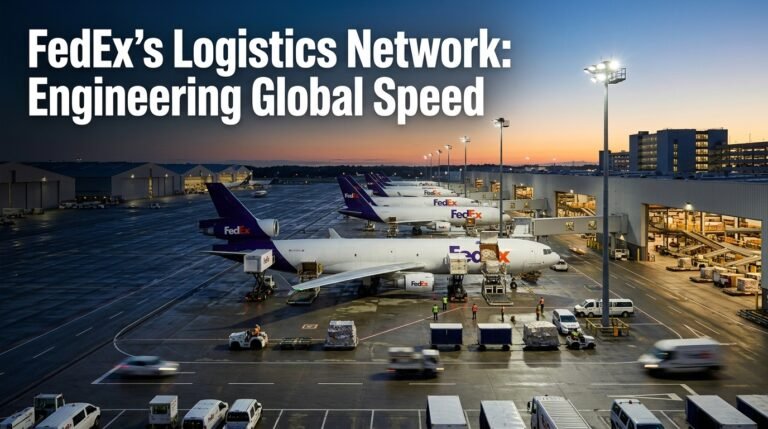
Global commerce moves at a tempo dictated by consumer expectation and industrial urgency. Critical components, temperature-sensitive pharmaceuticals, and time-definite retail parcels travel continents overnight. At the center of this capability sits FedEx Corporation, an enterprise that transformed freight transport from a fragmented relay into a synchronized global pipeline. Delivering millions of packages across more than 220 countries and territories daily is not merely an achievement of scale; it is an architectural masterclass in operations research, systems engineering, and predictive technology.
The Genesis: Pioneering the Hub-and-Spoke Architecture
Before 1971, point-to-point shipping dominated logistics. If a carrier needed to move a parcel from Atlanta to Denver, it relied on direct or multi-stop routing schedules that left planes underloaded, routes erratic, and transit times unpredictable. Frederick W. Smith recognized that point-to-point networks become exponentially inefficient as destinations multiply. Connecting $N$ nodes directly requires:
$$\frac{N(N – 1)}{2} \text{ routes}$$
By contrast, funneling volume through a central clearinghouse reduces route complexity down to:
$$N \text{ routes}$$
Smith’s solution—formalized in his Yale economics paper and operationalized as Federal Express—was the hub-and-spoke system. Instead of attempting to fly between hundreds of disparate cities, every aircraft flew into a single central node during the night: Memphis International Airport.
Point-to-Point Topology            Hub-and-Spoke Topology
   (Exponential Links)               (Linear Consolidation)

      [A] ----- [B]                       [A]     [B]
      / \       / \                         \     /
     /   \     /   \                         \   /
   [C] --- [D] --- [E]                 [C]--[ HUB ]--[D]
     \     /   \   /                         /   \
      \   /     \ /                         /     \
       [F] ----- [G]                      [E]     [F]
At the Memphis SuperHub, parcels were unloaded, sorted by destination within a tight multi-hour window, reloaded, and flown back out before dawn. This structure fundamentally changed air freight economics:
- Consolidated capacity: Flights ran at maximum density, slashing empty-seat miles.
- Deterministic transit windows: Delivery schedules shifted from approximate days to guaranteed hours.
- Decoupled origin and destination: Any single city gained instant connectivity to every other city in the network without requiring a dedicated corridor.
Today, while FedEx operates multiple regional megahubs—including Indianapolis, Guangzhou, Paris Charles de Gaulle, and Dubai—the core mathematical elegance of Smith’s original topology remains the backbone of express transport.
Infrastructure at Scale: The Physical Backbone
The physical manifestation of FedEx’s network operates as a coordinated multimodal matrix. Coordinating thousands of daily line-haul movements requires specialized physical assets built around strict mechanical tolerances.
Air Operations (FedEx Express)
Operating one of the world’s largest civil aircraft fleets, FedEx manages over 700 aircraft, ranging from Boeing 777Fs and 767-300Fs for intercontinental trunks to ATR 72s and Cessna 408 SkyCouriers for regional feeder runs. Flight paths are engineered to account for prevailing jet streams, noise-abatement restrictions, and runway availability, creating an aerial conveyor belt calibrated down to the minute.
Ground Integration (FedEx Ground & Freight)
The terrestrial counterpart integrates over 200,000 motorized vehicles, ranging from long-haul linehaul tractors to localized step vans. The ground topology relies on high-velocity sort facilities that balance speed against highway safety regulations, mandatory driver rest intervals, and regional traffic congestion patterns.
| Network Tier | Primary Asset Class | Operational Window | Primary Engineering Objective |
| Global Air Trunk | B777F, MD-11F, B767F | 21:00 – 04:00 (Local) | Rapid transcontinental transit and long-range density |
| Regional Feeder | ATR 72, Cessna 408 | 03:00 – 06:30 (Local) | Connecting tier-2/3 airports to primary air hubs |
| Highway Linehaul | Class 8 Tractor-Trailers | Continuous (24/7) | Bulk line-haul balancing cost efficiency and schedule |
| P&D (Last-Mile) | Step Vans, Cargo Sprinters | 08:00 – 19:00 (Local) | Route-density maximization and stop-cycle reduction |
The Memphis SuperHub: Anatomy of an Automated Engine
The Memphis SuperHub covers hundreds of acres, contains over 300 miles of conveyor belts, and processes roughly 500,000 packages per hour during peak sort operations. The sorting process follows an uninterrupted sequence:
[ Aircraft De-planing ]
          │
          ▼
[ Container Unloading (ULD Docks) ]
          │
          ▼
[ De-singulation & Alignment Lines ]
          │
          ▼
[ Six-Sided Optical Barcode/RFID Tunnel ]
          │
          ▼
[ Dynamic Shoe Sorters / Cross-Belt Trays ]
          │
          ▼
[ Destination Chutes & Container Packing ]
          │
          ▼
[ Outbound Air Staging & Loading ]
- Inbound De-nesting: Specially designed Unit Load Devices (ULDs)—contoured aluminum containers cut to match aircraft fuselage profiles—are pulled directly from main decks via hydraulic cargo loaders.
- De-singulation: Conveyors actively separate clusters of boxes into single-file streams using variable-speed friction belts.
- Six-Sided Scanning Arrays: High-speed omnidirectional cameras and laser tunnels scan package identifiers regardless of orientation, verifying dimensions, destination, and hazmat profiles in milliseconds.
- Active Divert Systems: High-speed mechanical shoe sorters and cross-belt trays slide packages onto designated destination chutes without stopping or jamming the main line.
- Containerization & Ramp Dispatch: Outbound containers are loaded, weight-balanced, tractor-towed across the ramp, and secured into outbound airframes before final flight departure windows close.
Data as Cargo: The Digital Shadow
Fred Smith famously stated that “the information about the package is just as important as the package itself.” Delivering physical goods reliably requires an identical digital copy moving parallel to the box.
Real-Time Visibility
In the late 1970s, FedEx introduced the digitally networked delivery tracking device—the SuperTracker—a handheld barcode scanner that recorded handoffs at every physical transition. Today, that framework has evolved into edge-connected IoT devices, such as FedEx’s SenseAware platform. Designed for high-value cold chain, clinical trials, and aerospace parts, these sensors log not just location via GPS and cellular triangulation, but:
- Ambient temperature
- Relative humidity
- Barometric pressure
- Light exposure (indicating opened containers)
- Shock and tilt incidents
Dynamic Predictive Routing
Static routing fails when weather fronts, maintenance holds, or highway closures intervene. FedEx deploys predictive systems that simulate operational scenarios hours before disruptions occur. When winter weather threatens Chicago O’Hare or Memphis, network dispatch algorithms automatically reroute regional feed volumes to alternative gateways like Indianapolis or Alliance Airport in Texas. By shifting flight plans and truck dispatches dynamically, the system absorbs bottlenecks before they cascade across the global network.
Network Modernization: The Drive Toward Unified Logistics
Historically, FedEx operated its primary networks—FedEx Express and FedEx Ground—as discrete operational entities. Express handled time-critical air volume via employee couriers, while Ground handled business-to-business and residential packages through independent service providers. While this separation optimized linehaul costs during earlier decades, the rise of e-commerce blurred the boundaries between speed, density, and package size.
Under modern transformation programs (such as the “One FedEx” consolidation initiative), the organization is integrating Express, Ground, and Freight operations into a unified system:
- Hybrid Sorting Facilities: Co-locating Express and Ground sorters in shared facilities removes redundant local routes and reduces empty vehicle miles.
- Smart Route Optimization: Machine-learning systems determine whether a parcel moves by air or surface based on transit deadlines rather than legacy division boundaries. If a parcel can hit its guaranteed deadline via an overnight truck linehaul, it bypasses the air network entirely, cutting carbon output and operational costs.
- Last-Mile Density Gains: By combining residential deliveries from multiple service levels into a single vehicle manifest, stops-per-mile increase, driving down the unit cost of final-mile delivery.
The Cold Chain and Specialized Precision
Not all shipments are durable parcels. The transportation of biopharmaceuticals, vaccines, and live biologicals requires precision environmental control alongside speed.
Deep Frozen (-150°C to -80°C) ──► Cryogenic Dry Vapor Shippers / Liquid Nitrogen
Dry Ice Frozen (-80°C to -20°C) ─► Monitored Solid CO2 Sublimation Packaging
Refrigerated (+2°C to +8°C)    ──► Phase Change Material (PCM) Active Cooling
Controlled Room (+15°C to +25°C) ─► Thermal Blankets & Vacuum Insulated Panels
To support these sensitive goods, FedEx maintains cold-chain centers across primary hubs. These facilities feature deep-freeze storage, phase-change re-icing capabilities, and continuous temperature logging.
When life-saving therapeutics enter the network, they receive priority loading, dedicated aircraft ramp lanes, and immediate sorting overrides, turning standard transit corridors into mobile temperature-controlled cleanrooms.
Structural Headwinds and the Road Ahead
Maintaining a global logistics machine faces persistent operational challenges:
- Decarbonization Pressure: Aviation accounts for a large portion of express logistics emissions. Balancing global speed commitments with net-zero sustainability goals requires heavy capital investments in Sustainable Aviation Fuels (SAF), fleet electrification, and energy-neutral sorting facilities.
- Geopolitical and Trade Volatility: Customs regulations, cross-border tariffs, and airspace restrictions demand resilient cross-border clearing engines capable of adapting to shifting international policies in real time.
- Autonomous Last-Mile Logistics: From autonomous middle-mile trucks running highway stretches to route-assisting robotics and AI dispatch engines, the next frontier focuses on removing manual handoffs from the supply chain.
The Science of Velocity
FedEx did not merely construct a shipping company; it engineered a synchronized physical network that underpins global commerce. By marrying the geometric efficiency of the hub-and-spoke model with high-speed automated material handling, enterprise-scale fleet orchestration, and real-time sensor intelligence, the company turned geographic distance into an operational variable that can be solved mathematically. As commerce continues to demand faster delivery and granular parcel visibility, the systems that engineer global velocity remain one of modern industrial operations’ most complex and reliable achievements.