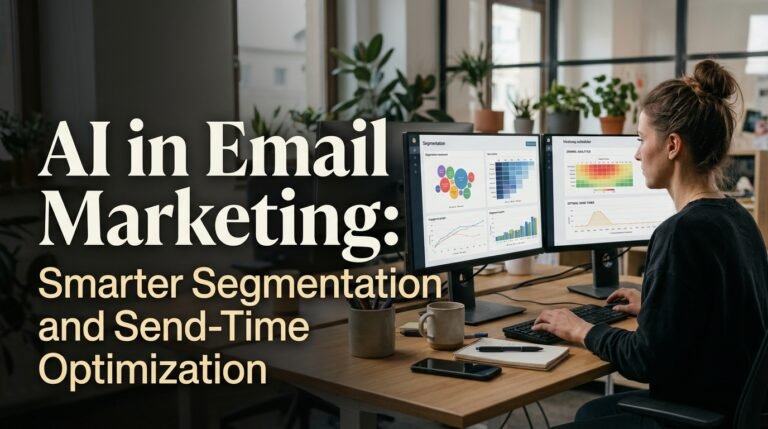
For decades, email marketing operated under rigid assumptions. Marketers spent hours slicing lists into static demographics—age, location, job title—and broadcasting campaigns on arbitrary schedule rules like “Tuesday at 10:00 AM.” While this broad-strokes approach delivered moderate returns in the early era of digital marketing, modern inboxes demand far higher precision.
Today’s subscribers are inundated with commercial messaging. Inbox providers deploy machine-learning filters to weed out low-engagement mail, and privacy architectures (such as Apple’s Mail Privacy Protection) have altered the accuracy of legacy email analytics. To capture attention and protect sender reputation, email marketing has evolved from rule-based automation into continuous, predictive intelligence.
At the epicenter of this transition are two foundational pillars: AI-powered dynamic segmentation and algorithmic Send-Time Optimization (STO). When executed together, they bridge the gap between static campaign blasts and hyper-relevant, 1-to-1 customer journeys.
1. The Fall of Static Segmentation
Traditional segmentation organizes audiences into rigid buckets:
- Demographics: Age, gender, region, company size.
- Historical Activity: Past 30-day purchases or basic sign-up dates.
- Broad Lifecycle Stages: Leads, active users, inactive contacts.
While these classifications establish a baseline, they fail to reflect real-time user intent. A contact tagged as an “enterprise buyer” might stop visiting your site for three months, while an “SMB lead” might visit your high-tier pricing tier five times in one weekend. Static lists cannot adapt dynamically without constant, cumbersome manual rebuilds.
Furthermore, over-segmenting using traditional rule builders often creates fragmented, high-maintenance lists that lead to overlapping automations, message fatigue, and subscriber burnout.
2. Smarter Segmentation: From Rule-Based to Predictive Clustering
Artificial intelligence transforms segmentation from a reactive categorization exercise into an automated, forward-looking engine. Rather than grouping contacts solely by what they did in the past, modern machine learning models predict what contacts are likely to do next.
Real-Time Behavioral Synthesis
Modern Customer Data Platforms (CDPs) and AI-driven Email Service Providers (ESPs) aggregate first-party signals across channels: in-app navigation, site search terms, cart activity, and cross-device interactions. Machine learning algorithms continuously ingest this telemetry to shift subscribers into relevant segments in real time:
- Micro-Intent Groups: Grouping users showing sudden, high purchase velocity or intent spikes within short windows (e.g., browsing a specific product tier multiple times within 48 hours).
- Fatigue Identification: Flagging subscribers whose engagement velocity is dropping, automatically reducing send frequency before they click “Unsubscribe” or report spam.
Predictive Analytics & Propensity Scoring
AI models assign continuous propensity scores to every subscriber on your list:
- Likelihood to Purchase (pCVR): Allocating direct product offers and limited-time incentives to subscribers with a high conversion score, while nurturing lower-scoring leads with educational thought leadership.
- Customer Lifetime Value (pLTV): Differentiating between high-value repeat shoppers and price-sensitive bargain hunters. High-pLTV contacts receive white-glove onboarding and VIP promotions, while one-off discount seekers receive margin-protective offers.
- Churn Risk Forecasting: Machine learning identifies subtle leading indicators of disengagement—such as shifting open-window intervals or reduced session lengths—enabling re-engagement workflows before churn occurs.
Unsupervised Clustering
Instead of marketers manually defining rules (e.g., “Purchased Category A + visited Category B”), unsupervised learning algorithms (such as k-means or Gaussian mixture models) detect latent behavior patterns across millions of data points. These clusters frequently reveal unexpected customer archetypes—like “weekend night-owl mobile shoppers” or “deep-dive technical evaluators”—that human operators would not identify on their own.
3. The Mechanics of Send-Time Optimization (STO)
Getting the right message to the right audience is only half the battle; arriving at the top of the inbox at the exact moment of engagement is equally critical.
The Flaw of Batch-and-Blast Timing
Email inboxes operate on reverse-chronological order or priority-ranked algorithmic feeds. When an email lands during a subscriber’s busiest meeting block, commute, or sleeping hours, it gets buried beneath dozens of subsequent notifications. Studies consistently show that an email’s likelihood of being opened decays sharply after the first 60 minutes of delivery.
How Algorithmic STO Operates
Send-Time Optimization replaces arbitrary bulk schedules with contact-level delivery windows. Rather than deploying 100,000 emails at 9:00 AM EST, the ESP calculates a rolling delivery schedule over a 24-hour window.
[Campaign Triggered]
         │
         ├── Contact A (Opens morning coffee: 07:15 AM) ──> Dispatched 07:12 AM
         ├── Contact B (Checks inbox lunch hour: 12:45 PM) ─> Dispatched 12:40 PM
         └── Contact C (Night reader: 09:30 PM) ───────────> Dispatched 09:25 PM
- Individual Activity Tracking: The engine builds an engagement distribution curve for each profile, tracking historical email opens, click interactions, site logins, and checkout timestamps.
- Contextual Calibration: The algorithm adjusts for the user’s local timezone automatically, avoiding midnight deliveries caused by mismatched database server settings.
- Continuous Updating: As a subscriber’s routine evolves—such as shifting from an office commute to remote work—the system updates its probability distribution based on the most recent interactions.
Navigating Apple Mail Privacy Protection (MPP)
Since Apple introduced MPP, automated pre-fetching of images masks the exact time a user opens an email in Apple Mail. Modern AI platforms solve this through multi-signal modeling:
- Incorporating direct click timestamps and downstream conversion data, which remain 100% accurate.
- Cross-referencing web and mobile app session telemetry to deduce active hours.
- Weighting high-confidence non-MPP opens alongside overall historical engagement trends.
4. Architectural Comparison: Legacy vs. AI-Driven Email
| Strategy Dimension | Legacy Email Marketing | AI-Driven Intelligent Delivery |
| Audience Grouping | Static lists, manual tags, hardcoded logic | Dynamic clusters, real-time recalculation, intent scoring |
| Delivery Schedule | Scheduled bulk blasts (e.g., Tuesday 10 AM) | Per-contact STO over 24-hour predictive curves |
| Churn Management | Post-churn win-back blasts (after 90+ days inactive) | Real-time predictive churn risk triggers |
| Workflow Maintenance | Heavy manual rule building and continuous list cleaning | Automated segment movement based on machine learning |
| Deliverability Impact | Sudden ISP spikes, higher bounce and spam risks | Smooth send throughput, optimized inbox placement rates |
5. Implementation Blueprint: Deploying AI Segmentation & STO
To capture the benefits of machine learning without overwhelming your operational workflow, roll out capabilities systematically across five distinct phases:
Phase 1: Clean First-Party Data Hygiene
Machine learning models depend strictly on the quality of their training inputs. Before enabling predictive features:
- Remove hard bounces, dormant contacts with zero engagement across 12 months, and unverified sign-ups.
- Ensure unified subscriber identifiers across your ESP, CRM, and website tracking scripts (e.g., standardizing on hashed email IDs).
Phase 2: Establish Predictive Segments
Enable your platform’s machine-learning segmentation features to build three primary dynamic lists:
- High Intent / Ready to Buy: Contacts exhibiting surge behavior across web and email channels.
- At-Risk Subscribers: Previously engaged contacts whose activity velocity has dropped below baseline.
- Core Champions: High-frequency, high-margin buyers suitable for brand advocacy and early-access campaigns.
Phase 3: A/B Test Send-Time Optimization
Avoid converting your entire email schedule overnight. Run structured A/B split experiments:
- Control: Standard batch send at your historically highest-performing static hour.
- Variant: 24-hour algorithmic STO delivery.
- Primary Metrics: Click-to-open rate (CTOR), revenue per recipient, and 48-hour total conversion rate.
Phase 4: Dynamic Content Pairing
Once segmentation and delivery windows are automated, align them with modular dynamic content blocks. Pair a subscriber’s predicted lifecycle stage with automated product recommendations and personalized subject line variations.
6. Deliverability and ISP Reputation Benefits
A frequently overlooked advantage of AI segmentation and STO is its positive impact on email deliverability.
Internet Service Providers (like Gmail, Yahoo, and Microsoft) evaluate incoming mail streams through machine learning to detect abusive behavior. Sending a massive volume burst of 200,000 emails in a single second triggers protective rate-limiting, throttling, or spam-folder redirection.
By distributing deliveries smoothly across the day to match individual subscriber open habits, STO naturally throttles volume into a balanced, organic traffic pattern. Combined with predictive segmentation—which ensures unengaged contacts receive fewer emails—this approach minimizes spam complaints and maintains high sender reputation scores.
The Strategic Shift
Artificial intelligence does not replace marketing creativity; it eliminates the guesswork of execution. By offloading segment clustering and delivery scheduling to algorithmic intelligence, marketing teams can redirect their energy toward high-leverage strategic priorities: clear brand messaging, high-converting creative concepts, and long-term customer relationship building.
The future of email marketing belongs to brands that treat the inbox as an adaptive, personal channel rather than a broadcast megaphone.