
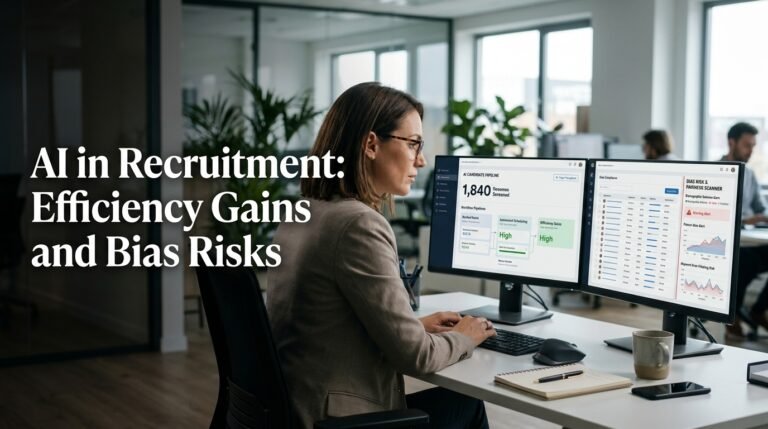
The modern corporate recruitment funnel has reached an unsustainable inflection point. Driven by remote work flexibility, one-click job applications, and automated career boards, talent acquisition teams regularly face thousands of inbound applications for a single opening. In response, enterprise human resources departments have turned toward artificial intelligence (AI) to automate sourcing, screen candidates, conduct initial assessments, and forecast candidate retention.
While the operational advantages—slashing time-to-hire, reducing recruitment overhead, and scaling candidate engagement—are undeniable, the rapid integration of machine learning into hiring has introduced profound systemic vulnerabilities. When historical biases, poorly trained models, and opaque decision architectures enter talent pipelines, automated efficiency can quickly turn into automated discrimination. Navigating AI in recruitment requires understanding both its operational potential and the ethical, legal, and operational risks that accompany algorithmic talent screening.
1. The Operational Engine: Where AI Drives Recruiting Efficiency
Talent acquisition has traditionally been constrained by linear human labor: recruiters must manually review resumes, coordinate calendars, and conduct preliminary phone screens. AI reconfigures this dynamic into scalable, asynchronous workflows.
High-Volume Resume Parsing and Candidate Matching
Traditional applicant tracking systems (ATS) relied on basic keyword density, which candidates routinely bypassed through keyword stuffing. Modern AI-driven recruitment platforms utilize Natural Language Processing (NLP) and semantic search models to parse resumes dynamically:
- Contextual Comprehension: Rather than searching solely for titles like “Product Manager,” NLP models evaluate contextual skill adjacencies, identifying equivalent competencies such as “backlog prioritization,” “cross-functional stakeholder management,” and “user story creation.”
- Multilingual and Format-Agnostic Parsing: Advanced models extract structured candidate profiles from unstructured CV formats, portfolios, and code repositories across multiple languages without requiring manual data re-entry.
Automated Sourcing and Talent Rediscovery
One of the most underutilized assets in large enterprises is the “talent graveyard”—past applicants stored within legacy ATS databases. AI sourcing agents scan internal archives alongside public platforms (e.g., GitHub, LinkedIn, Kaggle) to rediscover passive candidates whose profiles match newly opened requisitions, eliminating unnecessary ad spend on external job boards.
Pre-Screening and Conversational AI
Conversational bots powered by conversational agents handle initial applicant inquiries, verify basic prerequisites (work authorization, salary expectations, scheduling availability), and autonomously book interviews on hiring managers’ calendars. This automation eliminates administrative drag, shortening the feedback loop from days to seconds and significantly reducing candidate drop-off rates during initial intake.
Predictive Performance and Skill Assessments
AI-driven evaluation tools assess technical assessments and psychometric benchmarks. Machine learning algorithms analyze problem-solving sequences, coding efficiency, and standardized test logic to predict on-the-job competency, helping hiring teams move beyond credentialism (e.g., prestigious university degrees or specific employer pedigree) toward evidence-based screening.
2. The Algorithmic Blindspot: How Bias Enters the Hiring Pipeline
Despite marketing claims that machines evaluate candidates purely on merit, algorithms are not neutral arbiters. They reflect the mathematical patterns of their training data, feature selection, and developer assumptions.
| Bias Type | Mechanism | Manifestation in Recruitment |
| Historical Bias | Training models on past successful hires | Perpetuates demographic homogeny (e.g., favoring male applicants in engineering roles). |
| Proxy Discrimination | Correlating neutral features with protected attributes | Excluding candidates based on zip codes, collegiate sports, or graduation years. |
| Feature Extraction Bias | NLP and computer vision misinterpreting behavioral cues | Penalizing regional dialects, non-native accents, or non-traditional syntax. |
| Feedback Loop Drift | Algorithms optimizing for manager preferences over performance | Reinforcing manager bias by penalizing candidates from non-traditional backgrounds. |
Historical Data Bias: Encoding the Past into the Future
Machine learning models are backward-looking by design; they optimize for the attributes of individuals who were hired, promoted, and retained historically. If a company’s historical engineering cohort was 85% male, an algorithmic model trained to identify “successful candidate patterns” will infer that indicators correlated with female candidates—such as attendance at women’s colleges or participation in women’s professional organizations—represent negative signals.
This dynamic was notably illustrated when an early automated hiring tool at a major tech company was found systematically downgrading resumes containing the phrase “women’s” (e.g., “women’s chess club captain”), forcing the company to scrap the internal prototype entirely.
Proxy Variables and Statistical Surrogates
Even when sensitive demographic variables (gender, race, age, religion) are stripped from candidate profiles, algorithms frequently reconstruct them through proxy variables:
- Geography: Zip codes often closely correlate with racial and socioeconomic demographics.
- Extracurricular Activities: Participation in niche sports (e.g., polo, rowing, lacrosse) can serve as proxies for socioeconomic privilege.
- Graduation Dates: High school and college completion years directly expose an applicant’s age bracket, creating vulnerabilities to age discrimination.
Neurodiversity and Behavioral Analysis Pitfalls
Some hiring platforms deploy asynchronous video interviews where computer vision and vocal tone analysis score an applicant’s confidence, eye contact, and emotional affect. These models often establish narrow definitions of “professional engagement.” Candidates on the autism spectrum, neurodivergent applicants, or those with facial differences are frequently penalized by models that misinterpret unique facial movements, speech pauses, or atypical eye contact as disinterest or incompetence.
3. Regulatory and Legal Implications
The unchecked deployment of algorithmic hiring tools has sparked substantial scrutiny from international regulatory bodies and labor enforcement agencies.
The EU Artificial Intelligence Act (EU AI Act)
Under the European Union’s regulatory framework, AI systems used in recruitment, employee evaluation, and task allocation are explicitly classified as High-Risk AI Systems. Organizations deploying these technologies must comply with:
- Mandatory pre-deployment fundamental rights impact assessments.
- Strict data governance and bias testing standards.
- Human-in-the-loop oversight requirements.
- Detailed transparency and technical documentation disclosures.
United States: EEOC and Municipal Mandates
In the United States, the Equal Employment Opportunity Commission (EEOC) has issued formal guidance stating that employers are legally liable under Title VII of the Civil Rights Act if third-party algorithmic screening software produces an unlawful disparate impact against protected classes.
Locally, laws like New York City’s Local Law 144 (NYC LL144) require employers using Automated Employment Decision Tools (AEDTs) to subject their systems to independent annual bias audits and publicly publish the audit metrics, including selection rates across demographic categories.
4. Framework for Ethical and Compliant AI Deployment
Organizations that wish to capture the efficiency gains of recruitment technology without introducing compliance violations or cultural erosion must adopt rigorous operational safeguards.
Step 1: Conduct Independent Bias Audits
Never rely exclusively on vendor-provided fairness claims. Talent acquisition leaders must mandate independent, third-party audits of any AI engine introduced into the screening stack. Audits should calculate Adverse Impact Ratios (AIR) and verify compliance with the standard 4/5ths (80%) rule across race, gender, and intersecting demographic lines.
Step 2: Enforce Human-in-the-Loop Decision Gates
AI must function as an advisory tool rather than an autonomous decision-maker. Algorithms should assist in surfacing relevant candidates, highlighting skill proficiencies, or managing scheduling logistics, but should never be granted unilateral authority to issue candidate rejections or deliver employment offers without documented human review.
Step 3: Shift from Credential Matching to Skill Verification
Design parsing parameters around concrete job-related outputs rather than pedigree heuristics. Evaluating verified coding tests, writing samples, or technical assessments dramatically reduces reliance on past educational institutions and former employers—two categories heavily skewed by historic demographic inequities.
Step 4: Ensure Transparent Candidate Disclosure
Applicants should be notified when an AI system is deployed during their evaluation process, provided with an explanation of what inputs are analyzed, and offered an accessible accommodation or alternative human-evaluated pathway upon request.
Conclusion: Balancing Innovation with Accountability
Artificial intelligence offers human resource teams an unprecedented toolkit for managing volume, eliminating logistical friction, and uncovering non-obvious candidate talent. However, efficiency gained at the expense of equitable evaluation is an organizational liability.
The future of sustainable recruitment lies not in full automation, but in augmented intelligence—pairing the computational speed and pattern-recognition capabilities of machine learning with the ethical judgment, empathy, and contextual understanding of human recruiters. By implementing continuous auditing, regulatory compliance frameworks, and strict human oversight, organizations can modernize hiring pipelines while upholding fair and inclusive hiring standards.