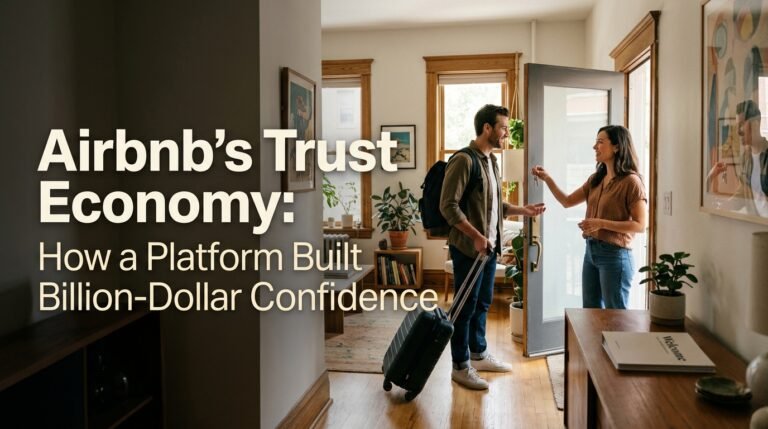
In 2007, when Brian Chesky and Joe Gebbia inflated three air mattresses on the floor of their San Francisco apartment to help pay rent, the premise was widely regarded by venture capitalists as untenable. Convincing ordinary people to open their private bedrooms to unvetted strangers—and convincing travelers to bypass established hotel chains to sleep in an unknown person’s home—ran contrary to fundamental social instincts. For generations, society had conditioned individuals to treat strangers with caution: Do not talk to strangers, do not enter an unfamiliar vehicle, and under no circumstances let an unvetted person into your house.
Two decades later, Airbnb hosts millions of guests across roughly 100,000 cities worldwide on any given night. The transformation of a high-risk peer-to-peer transaction into a multibillion-dollar public enterprise represents one of the most successful behavioural shifts in modern commercial history.
Airbnb did not merely build an accommodation marketplace; it engineered a trust architecture. By transforming social friction into quantifiable, manageable risk through interface design, algorithmic governance, and institutional guarantees, the company pioneered the mechanics of the modern platform economy.
1. The Anatomy of Stranger Danger: The Cold-Start Friction
In standard transactional economics, trust is heavily subsidized by institutions. When a traveler books a room at a hotel, their confidence stems from physical brand equity, corporate liability, centralized staff, and standardized building regulations. A bad experience can be escalated to an on-site manager; theft or damage is covered by corporate insurance policies; and physical keys are issued behind a formal reception desk.
Decentralized peer-to-peer exchanges lack this institutional scaffolding. Both participants face asymmetrical, high-stakes exposure:
- The Host’s Risk Profile: Renting a home exposes an individual’s most valuable asset to physical destruction, theft, squatting, and personal violence.
- The Guest’s Risk Profile: Staying in a stranger’s home introduces vulnerability regarding physical safety, fraudulent listings, hidden surveillance, hygiene, and last-minute cancellations leaving them stranded in an unfamiliar city.
Economist George Akerlof’s classic framework, The Market for Lemons, illustrates that when buyers cannot distinguish high-quality sellers from bad ones, information asymmetry causes buyers to discount the entire market, driving out honest participants until the ecosystem collapses. For Airbnb to survive past its initial niche of budget conference attendees, it had to design mechanisms that eliminated this asymmetry before a transaction ever took place.
2. Interface Engineering: Overcoming “High Social Distance”
Joe Gebbia, a designer by training, frequently cited research on “social distance”—the perceived similarity or affinity between individuals. People naturally trust people who resemble them in background, demographics, or immediate social circles. When social distance is wide, mistrust is the default.
Airbnb leveraged behavioral psychology and interface design to intentionally compress this distance:
A. The Symmetrical Profile & The Power of Disclosure
Early experiments demonstrated that anonymous profiles consistently failed to convert. Airbnb shifted from property-centric listings to human-centric profiles.
- High-Resolution Photography: Early on, the founders personally visited New York hosts to shoot high-definition photographs. Quality photography did not just make apartments look appealing; it signaled transparency and attention to detail.
- Biographical Framing: By requiring written bios, mutual languages, workplace or education affiliations, and clear self-portraits, the interface humanizes both sides.
- The “Goldilocks” Disclosure Curve: Airbnb’s internal data found that too little information triggered fear, while excessive, over-sharing profiles provoked suspicion. They calibrated input forms to guide users toward an optimal balance of personal warmth and transactional professionalism.
B. Pre-Booking Messaging Loops
Unlike automated hotel booking engines, Airbnb deliberately retained a degree of friction in its early checkout flows through the “Contact Host” feature. Requiring a brief introductory message allowed hosts and guests to evaluate social compatibility, establish expectations, and calibrate tone before financial commitments settled. This made the exchange feel less like an impersonal commercial contract and more like a social pact.
3. The Bilateral Feedback Loop: Weaponizing Reputation
Reputation systems had existed since eBay popularized buyer-seller star ratings in the late 1990s. However, eBay’s system was notoriously susceptible to retaliation: buyers feared leaving honest negative reviews because retaliatory sellers would ruin the buyer’s feedback score, leading to rampant grade inflation.
Airbnb revolutionized this dynamic by implementing blind, concurrent bilateral reviews:
- Simultaneous Revelation: Neither guest nor host can read the other’s review until both have submitted their feedback, or until the 14-day review window closes. This eliminates retaliatory scoring and dramatically increases honesty.
- Reputation Portability as Collateral: A host’s review score directly dictates their livelihood, search ranking, and nightly pricing power. For guests, an accumulation of verified, 5-star reviews functions as a digital passport. A single bad review can disqualify a guest from booking premier listings in the future.
- Private vs. Public Feedback Channels: Airbnb split reviews into two components: public ratings for prospective users and private operational feedback sent directly to the counterpart. This allowed hosts and guests to highlight minor gripes constructively without tanking public reputation scores over trivial issues.
By attaching durable, non-transferable reputation capital to user accounts, the platform turned good behavior into an economic incentive and poor behavior into an immediate operational liability.
4. Institutionalizing Safety: Mitigating Tail-Risk
Software design and social cues can mitigate day-to-day misunderstandings, but they cannot prevent low-probability, catastrophic events (e.g., vandalism, theft, or physical harm). When tail-risk events inevitably occurred—such as a heavily publicized 2011 incident where a San Francisco host had her home ransacked—Airbnb recognized that social trust alone is insufficient. The platform had to act as an economic backstop.
| Strategic Pillar | Mechanism | Economic & Behavioral Function |
| AirCover / Host Protection | Up to $3M+ in damage and liability coverage | Removes catastrophic financial risk, turning hesitant homeowners into active suppliers. |
| Financial Escrow | Airbnb holds guest payments until 24h after check-in | Protects guests from fraudulent listings; protects hosts from chargebacks and non-payment. |
| Identity Verification | Government ID matching, facial verification, and background checks | Prevents bad actors from cycling through burner accounts to evade platform bans. |
| Risk Scoring Algorithms | Real-time machine learning analyzing booking anomalies | Identifies high-risk reservations (e.g., local 1-night weekend bookings of large houses) to prevent unauthorized parties. |
By stepping in as the insurer and guarantor, Airbnb insulated participants from edge-case vulnerabilities. This gave participants confidence that if human trust failed, corporate capital would absorb the fallout.
5. Algorithmic Friction vs. Transaction Velocity
A central paradox in platform design is balancing transactional velocity (ease of purchase) against safety. Traditional e-commerce seeks to eliminate all friction—one-click buying is the gold standard. In a trust-sensitive marketplace, however, zero friction can degrade platform integrity.
Consider Airbnb’s evolution of Instant Book: When Airbnb introduced Instant Book (allowing travelers to reserve properties immediately without host pre-approval), many veteran hosts resisted. They feared losing control over who entered their homes.
To bridge this tension, Airbnb applied algorithmic constraints:
- Hosts could toggle Instant Book exclusively for guests who met strict verification criteria (e.g., valid government ID, positive reviews from prior hosts, no negative marks).
- Hosts were granted penalty-free cancellations if a guest violated house rules or made them uncomfortable during pre-arrival discussions.
Friction was not eliminated; it was targeted. Routine, high-trust transactions were streamlined to compete with hotel booking speeds, while irregular or unvetted transactions remained subject to manual verification.
6. The Structural Vulnerabilities of the Trust Economy
While Airbnb’s trust ecosystem scaled into a market cap surpassing legacy hotel conglomerates, operating a decentralized trust network introduces persistent vulnerabilities:
Review Inflation and Polarization
Because people understand that livelihoods are tied to review scores, ratings on Airbnb cluster heavily between 4.8 and 5.0. A 4.3 rating—which might indicate a solid, acceptable stay in another industry—can be fatal to an Airbnb host’s visibility. This binary distribution (either perfect or unacceptable) creates noise, forcing users to read between the lines of written descriptions rather than relying purely on aggregate scores.
Hidden Fees and Expectation Mismatches
Over time, the introduction of separate cleaning fees, administrative surcharges, and exhaustive guest checkout chore lists created friction. When a guest paying high service fees is asked to strip beds, wash linens, and take out trash, the psychological contract shifts from “welcoming peer community” to “exploitative service provider.” Airbnb responded by overhauling its pricing displays to show transparent total prices upfront, demonstrating that trust extends beyond physical safety to financial transparency.
Regulatory and Neighborhood Externalities
Trust between host and guest does not account for the third-party externality: the neighbors. A host may trust a guest, but the permanent residents of an apartment building did not sign up to live next door to an unregulated hotel suite. The friction between platform growth and local municipal governance—ranging from rent inflation concerns to quiet-enjoyment disputes—remains Airbnb’s most complex geopolitical challenge.
7. Strategic Lessons for Platform Builders
Airbnb’s journey provides a repeatable blueprint for founders and operators attempting to build two-sided marketplaces in high-risk categories:
- Trust Must Be Designed Before It Scales: Relying on basic marketplace dynamics without deliberate trust architecture inevitably leads to adverse selection. Design for vulnerability early.
- Reputation Needs Skin in the Game: Reviews are meaningless if users face no consequences for bad behavior or retaliation. Bilateral, blind review mechanisms protect signal clarity.
- Backstops Enable Participation: Users will tolerate small inconveniences, but they will not tolerate unhedged catastrophic loss. Providing tangible insurance and escrow mechanisms unlocks previously inaccessible supply.
- Balance Humanity with Automation: The platform economy does not succeed by replacing human connection with cold transactional interfaces; it succeeds by using software to make human interactions safe, predictable, and repeatable at scale.
By turning the psychological barrier of “stranger danger” into a managed, quantifiable experience, Airbnb demonstrated that trust is not a static cultural trait. It is a product feature—engineered, refined, and scaled across millions of doorways around the world.