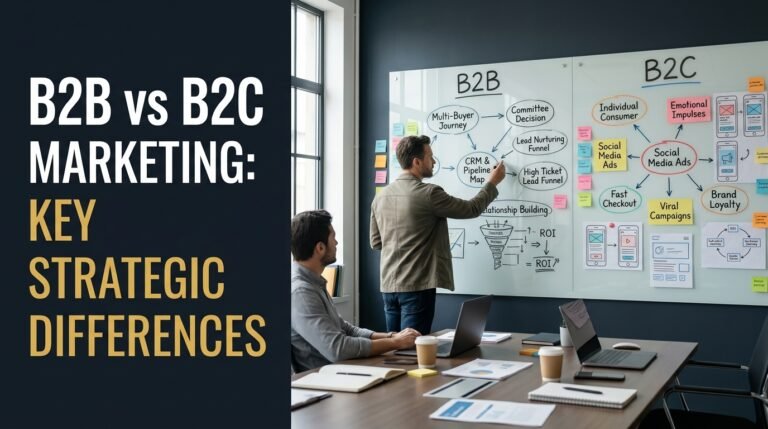
Marketing fundamentally boils down to connecting a specific solution with a defined human need. However, the operational machinery required to achieve that connection changes entirely depending on whether the customer is buying on behalf of an enterprise or for themselves.
At a superficial level, Business-to-Business (B2B) and Business-to-Consumer (B2C) marketing share standard channels: search engines, paid acquisition, social networks, email workflows, and creative assets. Beneath that layer, their core drivers, decision-making dynamics, economics, and metrics diverge sharply.
Understanding these differences is not just an academic exercise—it is essential for allocating capital, designing go-to-market motions, and avoiding costly strategic mistakes.
1. Target Audience and Buyer Psychology
The most significant divergence between B2B and B2C stems from the psychological context of the buyer.
B2B: Risk Mitigation, Accountability, and Consensus
In a B2B context, the person evaluating a product or service is an agent operating within a corporate hierarchy. Their buying decision is governed primarily by professional risk management and ROI.
- Buying Committees: Modern enterprise deals involve an average of 6 to 10 distinct stakeholders—ranging from end users and department heads to IT security, legal counsel, and finance teams.
- Loss Aversion: A consumer who makes a poor purchase might experience mild buyer’s remorse. A B2B decision-maker who selects the wrong ERP system or agency risks their professional reputation, internal standing, or career. Consequently, B2B purchasing logic is anchored heavily in proof, security, compliance, and peer validation.
- Logic Over Impulse: While emotional resonance and brand trust matter in B2B, the justification for the transaction must always be rational, measurable, and defensible to an internal committee.
B2C: Emotion, Identity, and Immediate Gratification
B2C transactions are largely individual decisions or shared within an immediate household.
- Emotional Drivers: Consumers buy based on identity, convenience, aspiration, status, or instantaneous problem-solving. A purchase often reflects who the buyer wants to be, how they want to feel, or how quickly they want relief from an annoyance.
- Solo Decision-Makers: The distance between impulse and conversion is exceptionally short. A single compelling hook or promotional discount can drive a purchase within seconds.
- Lower Perceived Risk: Because average order values (AOVs) are substantially lower than enterprise software contracts, the perceived risk of an individual transaction is minimal.
2. Sales Cycles and Funnel Velocity
The speed and complexity of the buyer’s journey dictate how marketing teams structure budgets and campaigns.
| Feature | B2B Marketing | B2C Marketing |
| Primary Target | Buying centers, enterprise committees | Individual consumers, households |
| Sales Cycle Duration | 3 to 12+ months | Minutes to a few weeks |
| Decision Drivers | ROI, risk reduction, workflow efficiency | Emotion, brand identity, convenience, price |
| Deal / Order Value | Moderate to exceptionally high ($10k–$1M+) | Low to moderate ($10–$1,000+) |
| Key Acquisition Channels | LinkedIn, SEO, webinars, account-based ads, events | TikTok, Instagram, Meta Ads, retail, Google Shopping |
| Conversion Focus | Qualified pipeline, pipeline velocity, LTV | High conversion rate (CVR), ROAS, repeat volume |
| Primary Content Format | Whitepapers, case studies, product tours, ROI calculators | Short-form video, lifestyle creative, user reviews, discounts |
The Long, Multi-Touch B2B Journey
A B2B deal often stretches across quarters. A prospect might discover a brand via a technical podcast, read three blog posts over four months, download an industry report, attend an educational webinar, and only then schedule a demo.
Because of this extended timeline, B2B marketing relies heavily on:
- Lead Nurturing Workflows: Automated, segmented email sequences that deliver incremental value over months.
- Account-Based Marketing (ABM): Tailoring acquisition and content strategies to specific high-value target accounts.
- Sales Enablement: Equipping account executives with one-sheeters, competitive battlecards, and ROI calculators to help internal champions sell upstream.
The Fast-Paced, Frictionless B2C Journey
B2C marketing prioritizes reducing friction to capture immediate intent. The journey from discovery to checkout is optimized for speed:
- Impulse Retargeting: Serving dynamic product ads showing the exact item left in an abandoned cart within hours.
- Zero-Friction Checkouts: Leveraging one-click checkouts, mobile wallets, and buy-now-pay-later (BNPL) integrations to prevent drop-off.
- Friction Elimination: Removing form fields, login requirements, and unnecessary steps that cause hesitation.
3. Messaging and Content Strategies
Content marketing plays a pivotal role across both landscapes, but the underlying narrative vehicles could not be more distinct.
B2B: Authority, Data, and Strategic Value
B2B prospects are not interested in flashy lifestyle imagery; they need clarity, utility, and concrete evidence.
- Case Studies with Hard Numbers: Statements like “Improved workflow” carry little weight compared to “Reduced developer deployment latency by 34% within 90 days.”
- Thought Leadership and Original Research: Proprietary benchmark reports, deep technical teardowns, and industry surveys build the brand authority needed to justify six-figure contracts.
- Tone of Voice: Professional, analytical, clear, and focused on operational outcomes.
B2C: Storytelling, Entertainment, and Community
In the consumer space, attention is scarce and fragmented. Content must entertain, inspire, or provide immediate visual proof before it sells.
- Short-Form Video & Visual Hook: Platforms like TikTok, Instagram Reels, and YouTube Shorts require content to capture interest within the first two seconds.
- Social Proof & Influencer Collaboration: User-generated content (UGC), unboxing videos, and authentic peer reviews outperform corporate product descriptions.
- Tone of Voice: Conversational, culturally relevant, humorous, or aspirational.
4. Channels, Tactics, and Distribution
Where you find your audience dictates how your marketing budget gets deployed.
B2B Channels
- LinkedIn: The undisputed center of gravity for professional networking, targeted account-based advertising, and executive thought leadership.
- High-Intent Search (SEO & SEM): Capturing buyers searching for category-defining keywords (e.g., “enterprise SOC 2 compliance automation” or “best supply chain visibility tools”).
- Industry Events and Private Dinners: High-touch in-person environments remain vital for closing large enterprise deals and building relationships with executive sponsors.
- Partner Ecosystems & Integrations: Listing in SaaS marketplaces (Salesforce AppExchange, HubSpot Marketplace) to reach established user bases.
B2C Channels
- Visual & Social Ads (Meta, TikTok, Pinterest): High-volume paid social campaigns driven by rapid creative testing, lifestyle photography, and algorithmic lookalike audiences.
- Influencer & Creator Networks: Partnering with micro and macro-influencers to leverage their built-in trust and distribution.
- Retail & Marketplace Distribution: Scaling presence across Amazon, direct-to-consumer (DTC) storefronts, and physical brick-and-mortar retail shelves.
- SMS & Direct Messaging: Using direct, high-open-rate channels for limited-time flash sales, loyalty rewards, and product drops.
5. Metrics, Economics, and ROI Evaluation
Because the transactional mechanics differ, success is evaluated through distinct operational KPIs.
B2B Economics: Pipeline and Expansion
B2B revenue models often center on annual recurring revenue (ARR) or high contract values. Consequently, standard e-commerce metrics like Return on Ad Spend (ROAS) are ineffective. Instead, B2B teams track:
- Customer Acquisition Cost (CAC) Payback Period: How many months of gross margin it takes to recover the marketing and sales expense of signing a customer.
- Marketing Qualified Leads (MQL) to Pipeline Conversion: Tracking the percentage of leads that advance to actual sales opportunities and closed revenue.
- Customer Lifetime Value (LTV): Measuring retention, upsell opportunities, and net revenue retention (NRR) over multi-year relationships.
B2C Economics: Velocity and Margins
B2C brands focus on unit economics and purchase velocity:
- Return on Ad Spend (ROAS): Direct revenue generated for every dollar spent on paid ad channels.
- Average Order Value (AOV): Maximized via bundles, cross-sells, and checkout upsells.
- Cart Abandonment Rate: Highlighting friction points within the checkout funnel.
- Repeat Purchase Rate: Determining whether retention and loyalty programs offset customer acquisition costs over time.
Where B2B and B2C Are Converging
While these foundational distinctions remain critical, the lines between B2B and B2C are blurring in two notable ways:
- The “B2C-ification” of B2B (Product-Led Growth): Modern enterprise users expect business software to be as intuitive, frictionless, and visually appealing as consumer apps like Spotify or Airbnb. Product-Led Growth (PLG) models allow individual employees to adopt a tool for free, forcing enterprise software to master consumer-grade onboarding and self-serve adoption before initiating top-down enterprise sales.
- B2B Buyers Are Still Humans: B2B marketing has historically suffered from dry, sterile corporate jargon. Marketers are recognizing that enterprise decision-makers scroll LinkedIn and watch YouTube videos during downtime; injecting human warmth, compelling storytelling, and sharp visual design into B2B brands consistently outperforms dated corporate templates.
Winning marketing strategies align their operating playbook with how the target customer actually buys. When targeting enterprises, optimize for risk reduction, educational depth, multi-stakeholder consensus, and account-level pipeline. When targeting consumers, optimize for emotional resonance, zero-friction discovery, community trust, and conversion velocity.