
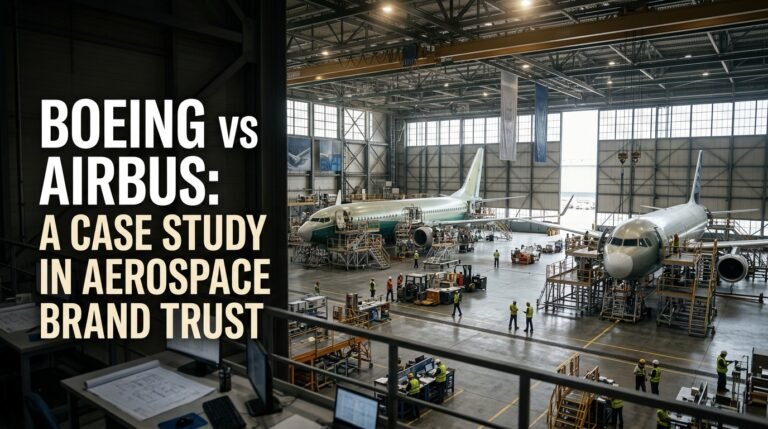
In high-reliability industries, brand trust is not built on advertising campaigns or logo redesigns; it is forged through zero-defect engineering, transparent governance, and an uncompromising commitment to safety. Few sectors embody this reality more acutely than commercial aerospace. For over five decades, the global civil aviation market has operated as a titan duopoly: the American aerospace stalwart Boeing and the European consortium-turned-conglomerate Airbus.
Historically, aviation brand equity operated primarily on a business-to-business (B2B) level. Airlines assessed dispatch reliability, fuel economics, fleet commonality, and pilot training cross-compatibility. The flying public was largely agnostic about aircraft airframes, famously captured by the mid-century adage: “If it ain’t Boeing, I ain’t going.”
In recent years, that paradigm shifted entirely. Systemic engineering failures, manufacturing lapses, regulatory scrutiny, and high-profile accidents transformed airframe selection into an end-consumer consideration. The divergence between Boeing and Airbus offers a textbook case study in how brand trust is accrued, dismantled, and systematically defended in a capital-intensive global marketplace.
1. The Historical Crucible: Engineering Prowess vs. Collaborative Innovation
To understand current brand positions, one must examine their foundational corporate cultures.
Boeing entered commercial aviation with deep institutional prestige. Founded in 1916, it established American dominance with legendary airframes like the 707, 727, and the Queen of the Skies, the 747. Its historical brand was synonymous with relentless engineering rigor, led by a culture where technical engineers held executive sway and safety margins were treated as immutable law.
Airbus, created in 1970 as an economic consortium uniting French, German, British, and Spanish interests, was initially perceived as an underdog political experiment. Because it could not rely on historical American aviation prestige, Airbus was forced to differentiate via technological leapfrogging.
- Digital Innovation: Airbus pioneered digital fly-by-wire controls, side-stick flight decks, and integrated flight envelope protections on the A320.
- Cross-Fleet Harmonization: Airbus introduced a uniform cockpit philosophy across narrow-body and wide-body platforms, cutting pilot type-rating training costs for airlines.
By the early 2000s, Airbus had caught up with Boeing in delivery volume, setting the stage for a tight, high-stakes duel over market dominance.
2. Culture Shift and the Erosion of the Engineering Ethos
The turning point in Boeing’s modern brand narrative traces back to the 1997 merger with McDonnell Douglas. While Boeing acquired its competitor, many industry analysts argued McDonnell Douglas’s financialized management ethos effectively acquired Boeing.
Shareholder value, stock buybacks, aggressive cost discipline, and decentralized manufacturing took precedence over the historic, engineer-first ethos. The development of the 787 Dreamliner introduced an outsourced, multi-tier supply chain model that led to delays, cost overruns, and early lithium-ion battery incidents.
When Airbus caught Boeing off-guard in late 2010 by announcing the A320neo (New Engine Option)—promising a double-digit percentage reduction in fuel consumption—Boeing faced severe commercial pressure. To counter airlines defecting to Airbus without undertaking a costly, decade-long clean-sheet narrow-body design, Boeing rushed the 737 MAX to market.
The consequences of prioritizing speed-to-market and regulatory avoidance over foundational design changes would trigger the most severe crisis in modern aviation history.
3. The Crisis Era: MCAS, Transparency Failures, and Systemic Oversight
The crashes of Lion Air Flight 610 in October 2018 and Ethiopian Airlines Flight 302 in March 2019 claimed 346 lives and triggered a global grounding of the 737 MAX fleet.
Subsequent congressional, judicial, and technical investigations exposed fatal vulnerabilities:
- The MCAS System: The Maneuvering Characteristics Augmentation System was designed to make the larger-engine MAX feel aerodynamically identical to earlier 737 variants, yet it relied on a single Angle-of-Attack (AoA) sensor without redundant verification.
- Concealment and Deregulation: The system’s full scope was withheld from airline pilot operating manuals to avoid mandatory simulator training that would delay entry into service.
- Regulatory Capture: Flaws emerged within the Federal Aviation Administration’s (FAA) Organization Designation Authorization (ODA) program, in which manufacturer employees performed critical certification tasks on behalf of the regulator.
The reputational damage was compounded by initial crisis communications that shifted blame toward pilot training rather than acknowledging fundamental design choices.
The return of the MAX after a 20-month grounding offered temporary stabilization, but deep-seated manufacturing vulnerabilities resurfaced in January 2024 when a door-plug blowout occurred on Alaska Airlines Flight 1282. The incident demonstrated that quality-control breakdowns had penetrated the factory floor, prompting federal production caps, executive turnover, and a direct threat to commercial market share.
4. Airbus’s Playbook: Methodical Execution and Market Realignment
While Boeing battled rolling crises, Airbus capitalized on operational discipline and methodical product strategy.
| Strategic Vector | Boeing | Airbus |
| Narrow-Body Flagship | 737 MAX Family (regulatory caps, delivery backlogs) | A320neo / A321neo / A321XLR (commanding market lead) |
| Wide-Body Strategy | 787 Dreamliner, 777X (certification delays) | A330neo, A350-900 / A350-1000 |
| Cockpit Philosophy | Traditional control yoke; pilot override authority | Side-stick fly-by-wire; hard flight-envelope limits |
| Supply Chain Posture | Re-integrating Spirit AeroSystems after heavy outsourcing | Integrated European production ecosystem with global assembly lines |
| Consumer Perception | High public scrutiny; heightened flight-tracker tracking | Stable, high baseline trust across major carriers |
Airbus dominated the lucrative middle-of-the-market segment with the A321neo and its extended-range variants (LR and XLR). By bridging regional thin routes and transatlantic travel with single-aisle economics, Airbus captured a durable order backlog that pulled its share of the narrow-body duopoly past 60%.
Airbus did not avoid industrial hurdles entirely—it managed its own titanium supply crunches and Pratt & Whitney geared-turbofan engine recall bottlenecks—but its airframe structural integrity, factory governance, and compliance standing remained free of systemic scandals.
5. B2B Realities vs. Consumer-Facing Reputational Shift
Historically, passenger preference rarely swayed airline procurement decisions. Aircraft purchases represent billions of dollars in multi-decade investments governed by operational economics, maintenance infrastructure, delivery slots, and financing terms.
Yet the modern digital landscape altered this equation:
- Consumer Flight Tracking: Travel aggregators, booking engines, and flight apps added features allowing passengers to filter flights specifically by airframe type.
- Corporate Travel Risk: Corporate travel management teams and airline executives faced direct inquiries from passengers hesitant to board specific aircraft types.
- Airline Customer Friction: When airlines grounded aircraft or delayed schedules due to regulatory mandates, the manufacturer’s supply-chain and certification setbacks directly diluted airline passenger goodwill.
When a brand crisis pierces through the B2B veil and shapes retail consumer behavior, the downstream economic risks compound across insurance, leasing rates, and customer renegotiations.
6. Strategic Imperatives for Rebuilding Trust
Restoring aerospace brand trust requires structural transformation rather than public relations campaigns. For Boeing, meaningful recovery rests on several fundamental pillars:
- Re-centering the Engineering Hegemony: Moving leadership away from purely financial engineering and returning governance to technical, safety-first personnel on the factory floor.
- Consolidating the Industrial Footprint: Bringing critical aerostructure manufacturing back under direct operational control to eliminate disconnected quality handoffs.
- Transparent Regulatory Engagement: Welcoming independent audits, empowering assembly-line whistleblower mechanisms, and avoiding accelerated certification targets that clash with rigorous verification.
- Clean-Sheet Innovation: Preparing the organizational architecture, financial reserves, and talent pipeline for the next generation of sustainable single-aisle aircraft to compete in the 2030s.
Brand trust in aerospace operates on an asymmetric curve: it takes decades of spotless execution to build, but can fracture in an instant when commercial expedience overtakes engineering integrity. While the sheer scale of global aviation demand ensures Boeing and Airbus will continue to share skies worldwide, Airbus stands as the benchmark for disciplined execution, while Boeing remains the modern archetype of the long, arduous journey to reclaim lost credibility.