Search engine optimization was once defined by exact-match strings. If you wanted to rank for “best project management software,” you sprinkled that exact phrase into your title tags, headings, image alt texts, and body copy at an ideal 2% to 3% density.
Modern search engines do not read the web as disconnected strings of characters. Instead, Google views the world through things, not strings.
Entity-based SEO is the practice of structuring, writing, and optimizing digital content around distinct concepts, people, places, and things—and explicitly defining the semantic relationships between them. By aligning your digital footprint with Google’s Knowledge Graph, you shift your site’s visibility from fragile keyword rankings to durable, machine-readable topical authority.
What Is an Entity in SEO?
According to Google’s own patent definition, an entity is:
“A thing or concept that is singular, unique, well-defined, and distinguishable.”
An entity does not need to be a physical, tangible object. It can be:
- Tangible Items: A person (Marie Curie), a city (Kyoto), or a landmark (The Colosseum).
- Abstract Concepts: An emotion (nostalgia), an economic theory (Keynesian economics), or a medical condition (type 2 diabetes).
- Organizations and Brands: A corporation (Alphabet Inc.), a non-profit (Red Cross), or an educational institution (Stanford University).
In Google’s database, each recognized entity has a unique machine identifier (often linked to knowledge repositories like Wikidata, Freebase, or the Knowledge Graph Search API).
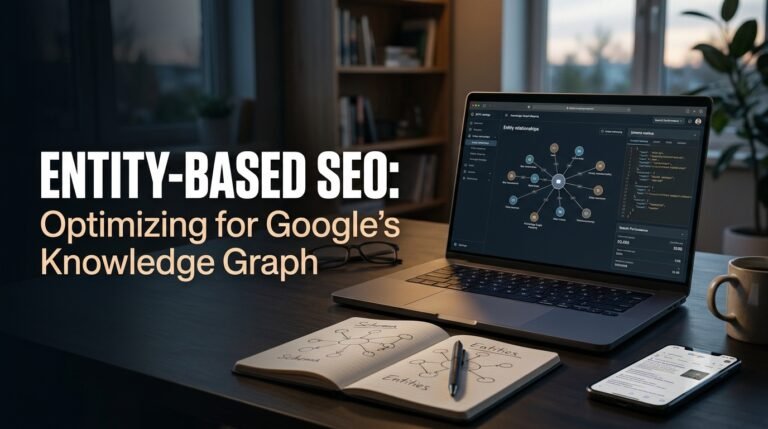
When Google parses a webpage, it extracts these entities and plots them as nodes in a massive graph. The connections between those nodes—such as “founded by,” “subsidiary of,” “symptom of,” or “author of”—are called edges.
How the Knowledge Graph Decoupled Search from Exact Keywords
The Google Knowledge Graph, introduced in 2012, operates as a massive semantic network that understands real-world relationships. Several major architectural milestones accelerated this transformation:
1. Hummingbird (2013)
The Hummingbird algorithm represented Google’s rewrite of its core parsing engine, shifting from cataloging isolated words to interpreting the conversational intent behind entire queries.
2. RankBrain (2015)
RankBrain incorporated machine learning to process queries Google had never encountered before (roughly 15% of daily searches), mapping unfamiliar phrases to known conceptual entities.
3. BERT & MUM (2019–2021)
Transformer-based language models revolutionized natural language processing (NLP). BERT helped Google understand prepositions, word order, and context (e.g., “can you get medicine for someone pharmacy”), while MUM (Multitask Unified Model) enabled multi-modal cross-lingual entity mapping across text, images, and video.
Instead of matching strings, Google asks: What entities are present in this query, and which web resources best satisfy the relational intent between those entities?
Keywords vs. Entities: The Conceptual Shift
Understanding the operational differences between keyword-centric and entity-centric optimization highlights why older optimization tactics fall short:
| Dimension | Keyword-Based SEO | Entity-Based SEO |
| Primary Unit | Text string (e.g., “cheap running shoes”) | Machine-identifiable concept (/m/019b9_) |
| Algorithmic Focus | Frequency, keyword density, exact placement | Contextual co-occurrence, semantic depth |
| Search Intent | Lexical match to user query | Entity attribute resolution & contextual intent |
| Site Architecture | Keyword silos targeting single-tail terms | Topical clusters covering entity sub-attributes |
| Structured Data | Basic markup for visual SERP snippets | Nested JSON-LD defining entity identities & relationships |
| Algorithm Defense | Vulnerable to NLP and core quality updates | Resilient; builds lasting domain authority |
Core Pillars of Entity-Based SEO Optimization
Transitioning to entity-based SEO requires architectural, technical, and editorial shifts.
1. Defining Your Brand as an Entity
Before Google can rank your site as an authoritative source on a topic, it must recognize your brand as a distinct entity in its Knowledge Graph.
- Claim and Optimize Knowledge Panels: Claim your Google Business Profile or brand Knowledge Panel. Ensure brand details match across directories, registries, and major profiles.
- Wikidata & Wikipedia Presence: Wikidata acts as a central structured data source for search engines. If your organization meets notability standards, establishing a verified Wikidata entry gives Google an unambiguous machine identifier for your brand.
- SameAs Attribute Matching: Use schema markup to point directly to external profiles (Crunchbase, LinkedIn, Wikipedia, Wikidata, official social profiles) so Google connects all endpoints to a single entity node.
2. Topical Authority via Entity Clustering
Google gauges expertise by whether a domain comprehensively covers an entity’s conceptual ecosystem. If you cover a core subject, you must also cover its primary attributes, related entities, and common sub-branches.
To build an entity-first cluster:
- Identify the Core Entity: (e.g., Cold Brew Coffee).
- Identify Primary Attributes: Brewing ratios, extraction temperature, shelf life, grind size, acidity levels.
- Identify Interconnected Entities: French press, Toddy system, caffeine concentration, nitro cold brew.
- Interlink Functionally: Use descriptive, contextual anchor text that reinforces the semantic relationship between pages, avoiding generic terms like “click here.”
3. Leveraging Natural Language Processing (NLP)
Google processes content using named entity recognition (NER), sentiment analysis, and syntax parsing. Content that ranks reliably avoids artificial keyword stuffing in favor of natural semantic co-occurrence.
When discussing Machine Learning, an authoritative document naturally references related entities without forcing them:
- Supervised learning
- Neural networks
- Backpropagation
- Overfitting
- Gradient descent
- Python / PyTorch
If an article on “Machine Learning” mentions none of these foundational co-occurring concepts, NLP models recognize the content as thin or superficial.
4. Advanced Semantic Schema Markup (JSON-LD)
Schema markup is the primary language webmasters use to pass structured entity data directly to Googlebot. Beyond standard BlogPosting or Article tags, entity-rich schema utilizes specific linking properties:
about: Identifies the primary entity the page covers.mentions: Identifies secondary entities referenced within the content.sameAs: Disambiguates an entity by linking to its authoritative reference (such as a Wikidata URL).
JSON
{
  "@context": "https://schema.org",
  "@type": "TechArticle",
  "headline": "Understanding Transformer Models in Deep Learning",
  "author": {
    "@type": "Person",
    "name": "Alex Mercer",
    "sameAs": "https://www.wikidata.org/wiki/Q11586234"
  },
  "about": [
    {
      "@type": "Thing",
      "name": "Transformer (machine learning model)",
      "sameAs": "https://www.wikidata.org/wiki/Q85810444"
    }
  ],
  "mentions": [
    {
      "@type": "Thing",
      "name": "Attention mechanism",
      "sameAs": "https://www.wikidata.org/wiki/Q105341258"
    },
    {
      "@type": "Thing",
      "name": "Natural language processing",
      "sameAs": "https://www.wikidata.org/wiki/Q30642"
    }
  ]
}
Step-by-Step Implementation Framework
Step 1: Run an Entity Extraction Audit
Paste your top-ranking pages into the Google Cloud Natural Language API demo. Inspect the output:
- Which entities does the model detect?
- What salience scores (0.0 to 1.0) does it assign to your core topics?
- Are irrelevant concepts receiving higher salience than your target subject?
If your page targets Enterprise CRM, but Google’s NLP parser tags Pricing, Contact Form, and Demo with higher salience than the software itself, rewrite your structural headers and lead paragraphs to center the primary entity.
Step 2: Query the Google Knowledge Graph Search API
Use Google’s Knowledge Graph Search API to verify how Google categorizes your niche.
Bash
https://kgsearch.googleapis.com/v1/entities:search?query=Content+Marketing&key=YOUR_API_KEY&limit=1
Review the returned @id, entity type, and description. This ensures your editorial terminology matches the terminology Google already recognizes.
Step 3: Align with E-E-A-T Principles
Experience, Expertise, Authoritativeness, and Trustworthiness (E-E-A-T) are fundamentally entity-level evaluations:
- The Author Entity: Who created the content? Do they have an existing footprint, published research, or recognized credentials?
- The Publisher Entity: What is the overarching reputation of the parent organization? Is it referenced by trusted external entities in news, academia, or industry bodies?
Reinforce author bios with explicit Person schema, links to external publications, and verifiable credentials.
Measuring Entity-Based SEO Success
Because entity optimization affects broad topical visibility rather than single-term positions, standard keyword rank tracking tools only paint part of the picture. Track these indicators to measure entity growth:
- Brand Knowledge Panel Presence: The appearance and stability of rich brand knowledge panels across branded and unbranded queries.
- Expansion of Long-Tail Impressions: Significant growth in impressions within Google Search Console for queries you never explicitly targeted in your copy.
- Broadened SERP Feature Inclusions: Increased inclusion in AI Overviews, People Also Ask boxes, and rich snippets.
- Citation in Generative Engines: Frequency of being cited as an authoritative source in large language model outputs across generative search experiences.
Entity-based SEO moves your strategy from gaming lexical algorithms to establishing permanent, machine-readable domain authority. When search engines clearly understand who you are, what you do, and how your expertise connects to the wider web, ranking follows as a natural byproduct of semantic relevance.