Modern buyers do not experience marketing in isolated touchpoints. A customer might discover a brand through a viral LinkedIn breakdown, evaluate alternative solutions across three podcasts and a Reddit thread, read peer reviews on G2, and only then search for the brand directly to book a demo.
Despite this reality, many growth teams continue to operate in silos: brand teams run awareness campaigns evaluated on impressions, while performance marketers run direct-response ads measured strictly by last-click return on ad spend (ROAS).
This fragmented approach creates high customer acquisition costs (CAC) and inconsistent brand messaging. A full-funnel marketing strategy bridges the gap between top-of-funnel brand equity and bottom-of-funnel conversion efficiency, treating the entire customer journey as an integrated, compounding engine.
1. What Full-Funnel Marketing Actually Means
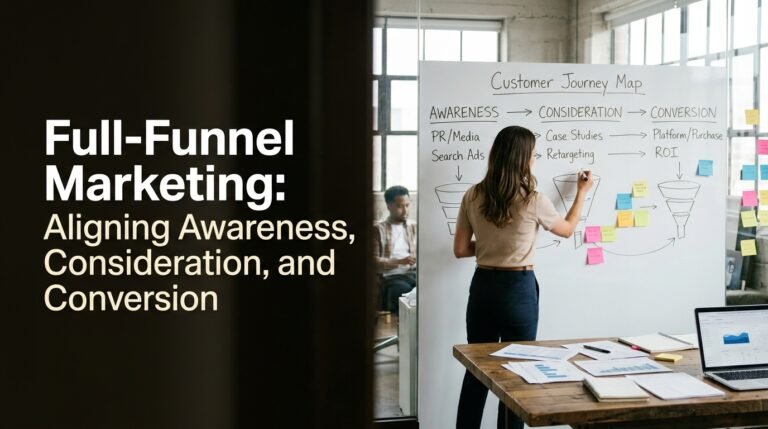
Full-funnel marketing is an operating framework that tailors content, channels, and messaging to match a prospect’s specific mindset at every stage of their buying journey:
- Top of the Funnel (TOFU): Awareness — The prospect realizes they have a problem or recognizes an unmet need.
- Middle of the Funnel (MOFU): Consideration — The prospect evaluates distinct categories, methodologies, and specific solutions.
- Bottom of the Funnel (BOFU): Conversion — The buyer is ready to decide and requires commercial validation, risk reduction, and frictionless purchasing paths.
Rather than treating these phases as separate handoffs across disconnected departments, a unified full-funnel approach orchestrates campaigns so that awareness initiatives feed qualified intent directly into conversion pathways.
2. Breaking Down the Stages: Channels, Formats, and Psychology
| Funnel Stage | Buyer Mindset | Core Objective | Primary Channels | High-Impact Formats | Key Metrics |
| Top of Funnel (TOFU) | Problem-aware or unengaged; seeking education or entertainment. | Build mental availability and establish authoritative point of view. | Organic Social, YouTube, Podcasts, PR, Digital Display. | Industry reports, thought leadership, explainer videos, educational guides. | Reach, Video Completion Rate (VCR), Engaged Sessions, Branded Search Volume. |
| Middle of Funnel (MOFU) | Solution-aware; comparing methodologies and vendor types. | Differentiate, prove technical competency, and capture contact details. | Search (Commercial Intent), Email Nurturing, Webinars, Remarketing. | Product comparisons, interactive calculators, webinars, teardowns. | Cost per Lead (CPL), Demo Requests, Content Downloads, Return Visitor Rate. |
| Bottom of Funnel (BOFU) | Vendor-aware; validating pricing, terms, security, and ROI. | Remove friction, derisk purchase, and close the sale. | Paid Search (Branded/Competitor), Retargeting, Direct Sales/Inbound SDRs. | Customer case studies, ROI calculators, free trials, product tours, sales decks. | Customer Acquisition Cost (CAC), Pipeline Velocity, Conversion Rate (CVR), Close Rate. |
3. Top of the Funnel (Awareness): Building Mental Availability
The objective at the awareness stage is not immediate lead generation. Demanding contact information or pushing a product demonstration at this point creates friction before value has been established. Instead, the goal is to build mental availability—ensuring your brand comes to mind when the customer eventually enters an active buying cycle.
Effective TOFU Tactics
- Point-of-View (POV) Content: Create definitive, opinionated content that diagnoses industry challenges better than competitors do. If your content clarifies a prospect’s problem more accurately than they can articulate it themselves, they naturally assume you possess the solution.
- Ungated Foundational Assets: Eliminate lead forms on introductory guides, high-level whitepapers, and podcast episodes. Frictionless distribution maximizes organic reach and establishes initial brand trust.
- Algorithmic Distribution via Native Content: Tailor content natively to the consumption habits of platforms like LinkedIn, YouTube, and specialized community forums rather than forcing immediate clicks out to external landing pages.
4. Middle of the Funnel (Consideration): Nurturing and Differentiation
Once a prospect understands their core challenge, they enter the evaluation phase. They are no longer asking “Why does this problem exist?” but rather “Which approach solves this best, and how do these vendors compare?”
At this stage, generic educational content loses efficacy. Buyers need actionable criteria to evaluate alternatives.
Executing the MOFU Transition
- Direct Category Comparisons: Avoid passive messaging. Publish direct comparison pages (e.g., Alternative to X, Vendor A vs. Vendor B) that transparently detail feature tradeoffs, ideal customer profiles, and pricing models.
- Interactive Tooling: Develop ROI calculators, interactive assessments, and diagnostic benchmarks. These formats provide personalized value to prospects while gathering qualifying data for sales and marketing automation.
- Structured Email Nurture Tracks: Segment automated email sequences based on the prospect’s initial entry point. If a user downloads an infrastructure security guide, their follow-up communications should focus on compliance architectures and vendor implementation requirements, not generic company updates.
5. Bottom of the Funnel (Conversion): Frictionless Decision-Making
At the bottom of the funnel, the prospect is evaluating deal terms, implementation risk, and operational viability. The objective shifts from education to de-risking the decision.
High-Converting BOFU Levers
- Evidence-Rich Case Studies: Move away from superficial testimonials. High-performing case studies detail baseline metrics, implementation timelines, technical roadblocks encountered, and verified business outcomes.
- Transparent Pricing & Product Tours: Complex qualification hurdles cause high drop-off rates. Providing on-demand interactive product demos (using tools like Navattic or Arcade) and transparent pricing tiers helps qualified prospects self-select and proceed with confidence.
- High-Intent Search Capture: Maintain continuous search coverage across your brand name, competitor comparison terms, and category transactional queries (e.g., “best enterprise SOC-2 compliance software”).
6. Aligning the Funnel: Overcoming Operational Friction
Building an effective full-funnel engine requires addressing common points of operational misalignment:
1. Unified Messaging Architecture
A common failure point is a messaging disconnect across stages. If awareness ads highlight cost reduction, but consideration landing pages focus exclusively on technical security features, prospects lose context. Maintain a centralized narrative spine where top-of-funnel promises map directly to middle-of-funnel features and bottom-of-funnel validation points.
2. Eliminating Metric Silos
When marketing teams optimize exclusively for platform-reported ROAS or volume-based Marketing Qualified Leads (MQLs), incentives skew toward low-intent conversions. Full-funnel operations demand shared accountability:
- Brand marketers must monitor whether top-of-funnel spend lifts downstream branded search volume and lowers overall blended CAC.
- Demand generation teams must monitor whether conversion campaigns draw from previously engaged audiences rather than relying entirely on cold, expensive paid search clicks.
3. Implementing Multi-Touch and Blended Attribution
Relying solely on last-click attribution undervalues TOFU investments, while first-click attribution ignores critical bottom-of-funnel conversion drivers.
To evaluate full-funnel efficiency accurately, combine:
- Blended Marketing Efficiency Ratio (MER): Total Revenue divided by Total Marketing Spend.
- Self-Reported Attribution (SRA): Adding a mandatory or optional “How did you hear about us?” open-text field on high-intent forms to uncover dark social channels (e.g., private Slack communities, podcasts, word-of-mouth).
- Platform Holdout Tests: Periodically pausing top-of-funnel channels in specific geographic regions to measure the downstream impact on organic traffic and inbound pipeline velocity.
A balanced full-funnel marketing strategy prevents reliance on volatile single-channel direct response tactics. By continually introducing new prospects to your perspective, guiding them through objective evaluation, and simplifying the final purchase decision, you construct a resilient, predictable acquisition engine.