
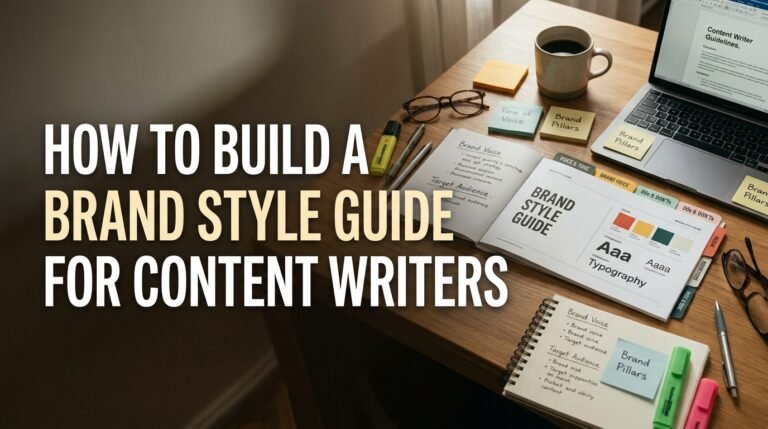
A company’s content is often produced by multiple hands: in-house marketers, freelance copywriters, agency partners, guest contributors, and subject matter experts. Without a centralized framework, this decentralization leads to disjointed messaging, erratic formatting, conflicting grammatical choices, and an inconsistent brand persona. One article sounds like an academic white paper, while the next reads like a casual social media post.
A brand style guide for content writers eliminates this friction. It serves as the single source of truth that translates high-level brand strategy into actionable, day-to-day writing standards. Far more than a simple list of grammar rules, an effective content style guide aligns tone, narrative perspective, vocabulary, and formatting across every touchpoint.
Building a style guide that writers will consult and follow requires a methodical approach that balances creative clarity with operational practicality.
1. Define the Core Mission and Audience Personas
Before detailing punctuation rules or formatting preferences, writers must understand the rationale behind the content: who they are writing for and what the brand stands to achieve.
Core Brand Mission and Value Proposition
Begin with a succinct summary of the organization’s mission, product or service offerings, and competitive positioning. Writers do not need the full corporate history, but they need enough strategic context to understand how individual articles fit into broader commercial goals.
- What problem does the company solve?
- Who are the primary competitors, and how does the brand differentiate itself?
- What overarching philosophy governs product design or client service?
Buyer Personas and Audience Segments
Writers cannot calibrate technical depth or tonal empathy without knowing the target reader. Detail two to four primary audience profiles, including:
- Job Titles & Seniority: (e.g., Enterprise IT Directors vs. First-time Homeowners)
- Pain Points & Frustrations: The acute operational or personal hurdles driving their search queries.
- Knowledge Baseline: Whether readers expect advanced industry terminology or require foundational concepts broken down without jargon.
- Content Objectives: What value the reader expects to extract—actionable frameworks, data validation, strategic clarity, or direct entertainment.
2. Establish Voice, Tone, and Personality
Voice and tone are frequently conflated, yet distinguishing between them is critical for written content.
Voice is the constant, unchanging personality of the brand.
Tone is the flexible mood or attitude applied depending on the context, format, and reader emotional state.
The Voice Spectrum: “This, Not That”
Abstract adjectives like professional, approachable, or innovative provide little concrete guidance. A practical way to clarify voice is the “This, Not That” comparative matrix.
| Brand Attribute | What It Means (Do This) | What It Avoids (Not That) |
| Authoritative | Base claims on verified data, primary research, and precise mechanisms. | Pompous, overly academic, or dismissive of alternative viewpoints. |
| Conversational | Use contractions, write in active voice, and address the reader directly using “you.” | Overly casual, slang-heavy, sloppy, or juvenile. |
| Actionable | Provide clear steps, concrete examples, and implementation blueprints. | Vague, high-level theory without pragmatic application. |
| Empathetic | Acknowledge user friction points with grounded, solution-oriented guidance. | Over-emotional, dramatic, patronizing, or overly familiar. |
Contextual Tone Shifts
Provide examples of how tone adapts across different content formats:
- In-Depth Technical Guides & White Papers: Objective, structured, and analytical. Minimal humor; focus remains on utility, precision, and logical flow.
- Blog Posts & Thought Leadership: Engaging, forward-looking, and conversational, leveraging real-world examples and rhetorical questions.
- Product Documentation & Help Center Articles: Concise, direct, neutral, and reassuring. Eliminate unnecessary narrative fluff so users can solve problems rapidly.
3. Standardize Formatting and Structural Conventions
Digital readability relies heavily on visual structure. Online readers scan content before committing to a full read. Standardizing formatting ensures consistency across your blog, knowledge base, and resource center.
Heading Hierarchies (H1 to H4)
Define heading casing and structure explicitly:
- Capitalization Style: Specify Title Case (“How to Structure Your Content”) or Sentence Case (“How to structure your content”). Sentence case is increasingly favored for modern digital products and readability.
- Heading Depth: Encourage writers to limit subheadings to H2 and H3 levels for standard articles, reserving H4 exclusively for nested technical documentation.
- Scannability: Mandate that headings must convey specific value rather than generic titles (e.g., use “Three Methods for Calculating Net Margin” instead of “Calculations”).
Paragraph and Sentence Construction
- Paragraph Length: Cap body paragraphs at 2 to 4 sentences (or roughly 50–75 words). Discourage large walls of unbroken text.
- Sentence Length: Aim for an average sentence length of 15 to 20 words. Encourage a natural rhythm by interspersing short, punchy sentences among longer compound sentences.
- Formatting Elements: Require bulleted lists for groups of three or more related items, numbered lists for strict sequential procedures, and callout blocks for warnings, tips, or core takeaways.
4. Compile Editorial Mechanics and Style Preferences
A content guide must adopt an established editorial baseline—such as the Associated Press (AP) Stylebook or the Chicago Manual of Style (CMOS)—to resolve everyday grammatical questions, then specify the brand’s unique exceptions.
Common Mechanical Choices
- The Oxford (Serial) Comma: Explicitly state whether to use the serial comma before the conjunction in a list of three or more items.
- With Oxford Comma: “We tested the software, reviewed the results, and deployed the update.”
- Without Oxford Comma: “We tested the software, reviewed the results and deployed the update.”
- Numbers and Figures: Specify whether numbers below 10 are spelled out (one through nine) and numerals used for 10 and above, or if numerical digits are preferred across all metrics (often preferred in technical or conversion-focused copy).
- Capitalization Rules: Clarify conventions for product features, proprietary platform modules, department names, and professional titles (e.g., capitalized before a name, lowercase when standalone).
- Punctuation and Symbols: Outline preferences regarding em-dashes (
—) versus en-dashes (–), spaces around dashes, percentage signs (%vs.percent), and ampersands (&reserved for tables/navigation vs. spelled out asandin body copy).
5. Build Terminology and Jargon Rules
Consistent naming conventions preserve brand equity and prevent customer confusion.
The Brand Vocabulary (Do’s and Don’ts)
Create a direct vocabulary table covering product nomenclature, industry concepts, and off-brand phrasing:
- Approved Brand Terms: State the precise spelling, hyphenation, and capitalization for the company name, integrations, and internal toolsets (e.g., SaaS Platform, AutoSync Module).
- Banned Words and Buzzwords: List tired industry clichés to avoid (e.g., synergy, game-changer, paradigm shift, ninja, rockstar).
- Substitutions: Provide preferred alternatives (e.g., use “integrate” instead of “leverage”, or “collaborate” instead of “synergize”).
6. Detail SEO and On-Page Optimization Guidelines
Content writers must balance brand storytelling with search discoverability. Include direct instructions for optimizing copy without compromising editorial integrity.
- Keyword Placement: Instruct writers on where to place the primary keyword naturally (e.g., Title/H1, within the first 100–150 words, one H2, and naturally throughout the text). Explicitly forbid keyword stuffing.
- Search Intent: Direct writers to examine search engine results pages (SERPs) before drafting to identify whether target queries require informational breakdowns, step-by-step tutorials, or commercial comparisons.
- Internal and External Linking:
- Require a minimum of 2 to 4 internal links to relevant product pages, cornerstone content, or related blog posts.
- Require all factual assertions, statistical metrics, and survey data to cite authoritative primary sources via external links. Mandate whether external links should open in a new tab (
target="_blank").
- Meta Data Deliverables: Require writers to submit a suggested meta title (50–60 characters) and meta description (140–160 characters) alongside every manuscript.
7. Provide Concrete “Good vs. Bad” Examples
Guidelines remain conceptual until writers see them demonstrated in practice. The most effective section of any style guide is a side-by-side comparison illustrating common editorial pitfalls and their approved revisions.
Example: Explaining a Complex Technical Feature
- Poor Execution (Verbose, Passive, Jargon-Laden):“It should be noted that in order to effectively utilize the platform’s cutting-edge functionality, an enterprise must proactively synergize their distributed database clusters with our robust automated cloud pipeline.”(Critique: Passive phrasing, buzzword-heavy, ambiguous benefits, empty adjectives.)
- Approved Execution (Direct, Active, Reader-Centric):“Connect your database clusters to our cloud pipeline in three steps to automate data synchronization across every distributed team.”(Critique: Action-oriented verb, clear outcome, eliminates needless buzzwords.)
8. Roll Out, Enforce, and Maintain the Guide
A style guide delivers value only if writers routinely reference it. The rollout strategy should make the guide accessible, integrated into workflows, and adaptable over time.
Centralized Storage and Accessibility
Host the guide where contributors work daily—such as Notion, Google Docs, Confluence, or an internal web page. Avoid distributing static PDFs that quickly become obsolete. Ensure external freelancers receive the link immediately during their onboarding process.
Automated Tooling and Linters
Reinforce your standards by integrating style rules into writing assistants:
- Configure platforms like Grammarly Business, Writer.com, or Hemingway Editor with your custom vocabulary, banned words, and style preferences.
- Supply standard article templates containing pre-formatted heading levels, meta data sections, and author bio blocks.
The Feedback Loop
Treat the style guide as an iterative document. As the product evolves, audience segments shift, or new content formats (such as video scripts or newsletters) emerge, update the guide accordingly. Schedule a biannual editorial review to prune outdated rules, incorporate recurring editor feedback, and add fresh “Good vs. Bad” examples.