Selling a $50 e-commerce product relies on transactional impulse: clear product photography, social proof, and a streamlined one-click checkout. Selling a $5,000, $20,000, or $100,000 service demands an entirely different psychology.
When enterprise buyers, founders, or affluent individuals commit significant capital to a service, they are not merely purchasing deliverables—they are taking on career, operational, or financial risk. A broken product can be refunded; a botched custom enterprise software implementation, brand overhaul, or corporate legal restructure can set an organization back months.
Because risk perception scales directly with price, high-ticket marketing funnels must be engineered around perceived certainty, authority, and friction-controlled qualification.
1. The Anatomy of a High-Ticket Funnel
Traditional marketing funnels guide prospects through a wide top, a nurturing middle, and a direct checkout bottom. A high-ticket funnel, by contrast, functions less like an open slide and more like a sequence of deliberate filters.
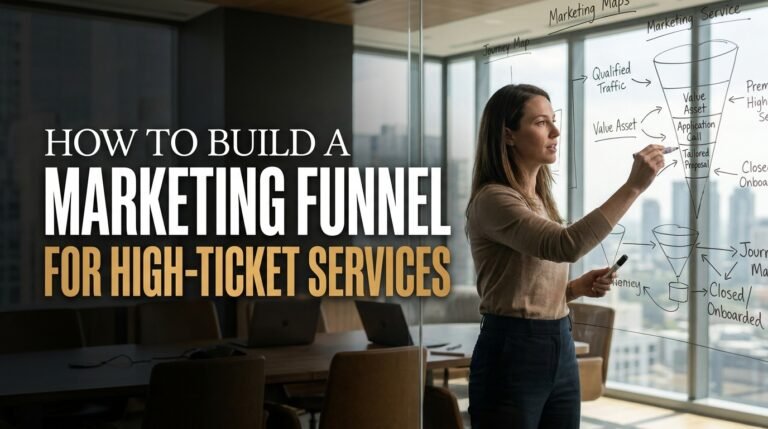
       [ TOP OF FUNNEL: Targeted Demand Generation ]
         Cold Traffic / Organic / Referrals / Direct
                             │
                             ▼
     [ MIDDLE OF FUNNEL: The Value & Trust Bridge ]
      Case Studies, In-Depth Breakdowns, VSLs, Assets
                             │
                             ▼
     [ QUALIFICATION GATE: Application & Diagnostic ]
         Pre-call filtering, Budget, Strategic fit
                             │
                             ▼
    [ BOTTOM OF FUNNEL: Two-Step Consultative Sales ]
       Discovery / Audit  ──►  Proposal / Strategy Deck
                             │
                             ▼
          [ POST-CALL: Retargeting & Long-Term Nurture ]
The objective is not to maximize conversion volume at every step, but to maximize pipeline quality while protecting your team’s most constrained asset: senior consulting and sales time.
2. Top of Funnel (TOFU): High-Intent Attraction
High-ticket buyers rarely spend time clicking through superficial social ads promising “one simple trick.” They look for specialists who demonstrate an acute understanding of their specific industry bottlenecks.
Identifying the Niche Problem
High-ticket pricing requires extreme specialization. If you position yourself as a generalist (“We do web design for all businesses”), you compete on price against global marketplaces. If you specialize (“We architect HIPAA-compliant web portals for clinical trial networks”), your pricing power expands exponentially.
Your top-of-funnel content must solve a single, painful, well-defined problem.
Traffic Channels That Deliver Enterprise Buyers
- Account-Based Marketing (ABM) & Cold Outbound: Build highly targeted lists of 200–500 ideal accounts. Deliver hyper-personalized insights, video audits, or bespoke teardowns directly to key decision-makers.
- Organic Thought Leadership (LinkedIn & YouTube): Publish technical breakdowns, architecture walk-throughs, and strategic frameworks. Long-form video and long-form written posts perform exceptionally well for high-ticket B2B buyers because they provide space to demonstrate deep domain expertise.
- Intent-Driven Paid Search (Google Ads): Target buyers actively seeking solutions with terms like “custom EHR development firm” or “fractional CFO for SaaS series B.” Avoid high-volume informational keywords; focus on high-intent commercial phrasing.
3. Middle of Funnel (MOFU): The Trust & Proof Engine
Once an enterprise prospect enters your ecosystem, they need clear evidence that you can reliably deliver outcomes before they will commit 45 minutes to a call.
The Problem With Generic Lead Magnets
Checklists, 2-page PDFs, and generic cheat sheets fail in high-ticket environments because they signal low production value and surface-level thinking.
High-ticket lead magnets should act as standalone assets:
- The Diagnostic Audit / Calculator: A proprietary tool that benchmarks a prospect’s metrics against industry standards.
- The Tactical Video Sales Letter (VSL): A 15-to-25 minute strategic video breaking down your proprietary mechanism, how previous clients scaled, and why conventional solutions fail.
- The Forensic Case Study: Rather than a simple testimonial quote, present an unvarnished breakdown of a real engagement: the client’s initial bottleneck, the failed prior attempts, the exact system deployed, and the measurable financial return.
| Asset Type | Best Suited For | Key Objective |
| Forensic Case Study | Corporate & Enterprise B2B | Prove risk mitigation and repeatable ROI |
| Framework VSL | Mid-market & High-Ticket B2C | Clarify your proprietary mechanism and worldview |
| Interactive Audit Tool | SaaS, Tech, & Financial Services | Expose unrealized operational leaks and quantify upside |
4. The Qualification Gate: Filtering Tire-Kickers
One of the most expensive errors in high-ticket service operations is letting unqualified leads book directly onto an expert’s calendar. Friction in the application process is not an obstacle—it is an intentional filter.
The Multi-Step Application Form
Position your intake form as a strategic intake or application, never a simple “contact us.” Keep questions direct, clear, and relevant to qualification:
- Primary Business Objective: What is the single biggest milestone you need to achieve in the next 6 months?
- Current Baseline Metrics: What is your current monthly revenue, pipeline volume, or infrastructure capacity?
- Budget Alignment: Are you prepared to allocate a minimum of [$X] to resolve this problem if the strategy aligns?
- Decision Authority: Who else within your leadership team needs to be involved in approving this project?
If an applicant lists a budget below your baseline, route them automatically to lower-tier resources, recorded trainings, or an email nurture sequence. Reserve calendar links exclusively for leads that meet your criteria.
5. Bottom of Funnel (BOFU): The Consultative Sales Sequence
High-ticket service sales should never resemble high-pressure pitching. The sales dynamic must position your team as specialized diagnosticians advising a patient, not vendors begging for business.
The Two-Call Architecture
For contracts exceeding $10,000, split the sales cycle into two deliberate touchpoints:
- The Diagnostic Call (15–25 Minutes):
- Review their current architecture, team structure, or strategic roadblocks.
- Confirm strategic fit and budget viability.
- Frame whether their problem is one you can definitively solve.
- If aligned, invite them to a formal Strategy & Blueprint presentation.
- The Strategy & Proposal Call (45–60 Minutes):
- Walk through a tailored scope of work, timeline, and deliverables.
- Connect every component directly to the financial or operational upside discussed during the diagnostic.
- Address organizational risks and internal implementation hurdles up front.
- Secure verbal commitment or clearly identify final stakeholder sign-offs.
6. Post-Call Follow-Up and Long-Term Nurture
High-ticket sales cycles frequently take 30 to 90 days. Deals rarely close on the first proposal call, especially when multiple enterprise stakeholders must sign off.
Dynamic Pipeline Retargeting
Set up custom audience retargeting on LinkedIn and Google Display for prospects who have visited your application or proposal pages:
- Founder Interviews & Media Mentions: Reinforces industry prestige.
- Client Video Spotlights: Reinforces confidence while the deal is in review.
- System Updates: Highlights continuous improvements in your processes or technology.
Weekly Insights Newsletter
Send high-value, educational dispatches directly to stalled leads and active prospects. Analyze recent regulatory changes, publish engineering retrospectives, or review market shifts. Keep your firm top of mind so that when internal budget cycles unlock, your team is the default partner.
Key Metrics to Monitor
To keep your high-ticket funnel running predictably, track these fundamental pipeline ratios rather than surface-level vanity metrics:
- Application Completion Rate: Percentage of landing page visitors who complete the qualification intake (target: 3–8%).
- Lead Qualification Rate: Percentage of applicants who meet your minimum budget and criteria (target: 40–60%).
- Show-Up Rate: Percentage of qualified applicants who attend the diagnostic call (target: 80%+).
- Diagnostic to Proposal Rate: Percentage of initial calls that progress to a formal strategy presentation (target: 50–70%).
- Proposal Close Rate: Percentage of presented proposals that convert into signed contracts (target: 25–40%).
By systematically building each stage around proof, selective qualification, and consultative advisory, your funnel transforms from an unpredictable hustle into an engine of high-margin client acquisition.