In modern commercial branding, “purpose” is frequently treated as an afterthought—an executive PR campaign, a colorful badge on a corporate website, or an ESG disclosure tucked away in an annual report. Consumers, increasingly sensitized to performative posturing, routinely spot and reject greenwashing.
Yet, one brand has consistently operated on a model where mission precedes merchandise: Patagonia.
Founded in 1973 by rock climber, equipment designer, and environmentalist Yvon Chouinard, Patagonia did not adapt its business model to align with sustainability trends. It built its entire operating thesis on the premise that corporate enterprise is accountable to the ecosystem it extracts from. Far from diminishing financial viability, Patagonia’s unapologetic, activist stance has generated exceptional brand equity, deep consumer loyalty, and durable enterprise value.
Examining Patagonia’s marketing reveals how aligning authentic conviction with functional product excellence creates an enduring commercial moat.
1. The Anti-Marketing Paradigm: Selling Less to Earn More
Conventional retail marketing follows a predictable playbook: drive high volume, accelerate seasonal turnover, induce artificial urgency, and maximize cart size.
Patagonia broke that playbook entirely on Black Friday in 2011 by running a full-page advertisement in The New York Times with a stark photo of its flagship fleece and a bold headline: “Don’t Buy This Jacket.”
                     CONVENTIONAL VS. PURPOSE MARKETING
 ┌───────────────────────────────────────┬───────────────────────────────────────┐
 │       Traditional Retail Model        │       Patagonia's Counter-Model       │
 ├───────────────────────────────────────┼───────────────────────────────────────┤
 │ Planned obsolescence & rapid cycles   │ Radical durability & Ironclad repairs │
 │ Discounting to create buying urgency  │ Discouraging unneeded purchases       │
 │ Maximizing short-term quarterly sales │ Extending multi-decade product utility│
 │ Vague corporate sustainability claims │ Radical supply chain transparency     │
 └───────────────────────────────────────┴───────────────────────────────────────┘
The copy broke down the hidden environmental footprint required to manufacture the R2 fleece: 135 liters of water, 20 pounds of carbon emissions, and substantial material waste. It urged customers to reconsider buying what they did not need, repair what was worn, and recycle what was exhausted.
The immediate outcome seemed paradoxical: sales surged by approximately 30% following the campaign.
This was not cynical reverse psychology; it was a demonstration of radical brand integrity. By telling consumers not to buy unnecessarily, Patagonia separated itself from mass apparel commoditization. Customers realized that if Patagonia advocated against frivolous purchases, the garments they did sell were built to last. The message anchored quality and durable utility at the center of the consumer relationship.
2. Closing the Loop: The Circular Economy as a Product Strategy
Purpose-driven positioning falls flat when unsupported by post-purchase reality. Patagonia backs its ethos with concrete circular initiatives:
The Worn Wear Initiative
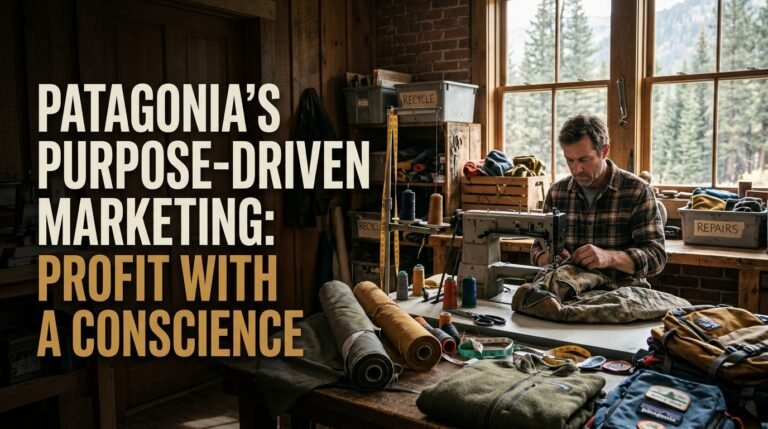
Launched to normalize garment longevity, Worn Wear serves as both an operational repair network and a vibrant content hub. Patagonia operates dedicated repair hubs and deploys mobile repair vans equipped to fix ripped seams, broken zippers, and worn fabrics—frequently repairing gear made by competing brands as well. Through its trade-in platform, customers exchange functional used items for store credit, which Patagonia cleans, repairs, and resells at approachable price points.
The Ironclad Guarantee
By offering a lifetime repair or replacement warranty, Patagonia transfers durability risk from the consumer to the manufacturer. This shifts the internal design imperative from cheap mass manufacturing to repairable, rugged engineering.
The Footprint Chronicles
In an industry notorious for opaque, subcontracted supply chains, Patagonia launched The Footprint Chronicles. This interactive tool details the origins, labor standards, and ecological footprints of its suppliers, mills, and distribution networks. Instead of concealing production flaws, the company publicly documents both its progress and the areas where it falls short of its environmental targets.
3. Brand Activism: Putting Skin in the Game
Many corporations adopt cause marketing through innocuous slogans that risk offending nobody. Patagonia, by contrast, takes explicit, combative stances on ecological preservation:
- 1% for the Planet: Since 1985, Patagonia has committed 1% of total sales—not net profits—to grassroots environmental non-profits, formalizing this in 2002 via the 1% for the Planet alliance. This “Earth Tax” persists regardless of whether the business experiences a banner year or a downturn.
- Defending Public Lands: In December 2017, when the U.S. administration moved to dramatically reduce the boundaries of Utah’s Bears Ears and Grand Staircase-Escalante National Monuments, Patagonia transformed its homepage into a stark, black-and-white declaration: “The President Stole Your Land.” The company subsequently filed a federal lawsuit to block the executive order.
- Voting & Civic Engagement: The company frequently closes its stores, headquarters, and distribution centers on national election days, paying employees while encouraging voter participation and civic activism.
This brand activism inevitably alienates portions of the market. However, in an oversaturated retail landscape, building a razor-sharp emotional bond with a loyal core community is far more valuable than maintaining bland, universal palatability.
4. The Structural Capstone: “Earth is Now Our Only Shareholder”
The tension within purpose-driven corporate capitalism is the constant pressure of external capital. Public shareholders and private equity sponsors generally demand short-term margin expansion, cost-cutting, and perpetual quarterly growth.
In September 2022, Yvon Chouinard resolved this structural tension with an unprecedented corporate reorganization. Rather than taking the company public or selling it to an apparel conglomerate, the Chouinard family forfeited 100% of their ownership:
                    PATAGONIA OWNERSHIP ARCHITECTURE
                                   │
         ┌─────────────────────────┴─────────────────────────┐
         ▼                                                   ▼
┌──────────────────────────────┐            ┌──────────────────────────────┐
│   Patagonia Purpose Trust    │            │     Holdfast Collective      │
│     (2% of Total Stock)      │            │     (98% of Total Stock)     │
├──────────────────────────────┤            ├──────────────────────────────┤
│ Holds 100% of voting shares  │            │ Holds non-voting shares      │
│ Mandated to protect core     │            │ Receives all yearly dividends│
│ values, culture, and purpose │            │ to combat climate change     │
└──────────────────────────────┘            └──────────────────────────────┘
Every dollar of profit not reinvested into operating the enterprise is distributed to the Holdfast Collective to protect biodiversity, fund climate litigation, and restore wild habitats.
This corporate governance model solved the existential challenge that confronts most legacy brands upon founder departure: how to shield corporate purpose from short-term financialization.
5. Strategic Takeaways for Modern Marketers
Patagonia’s enduring market leadership offers fundamental lessons for brands seeking to balance purpose with sustainable margins:
- Build a Superior Core Product FirstPatagonia’s environmental advocacy functions only because its technical apparel is exceptionally well-engineered. Purpose cannot compensate for poor materials, indifferent customer service, or flawed ergonomics.
- Prioritize Skin in the Game Over SlogansPledging a fixed percentage of topline revenue, repairing used garments for free, and turning away revenue that contradicts company values establish undeniable proof of commitment.
- Embrace Transparent VulnerabilityModern audiences do not expect perfection; they demand honesty. Openly discussing supply chain hurdles or material limitations builds stronger customer trust than manicured public relations scripts.
- Resist the Disposable CultureDesigning for longevity and offering circular trade-in channels elevates perceived brand value, defends pricing power, and fosters lifelong customer relationships.
Patagonia provides undeniable proof that purpose and profit are not mutually exclusive. By transforming environmental stewardship from a quarterly marketing tactic into its primary business engine, the company has rewritten the rules of modern brand building—proving that the most durable way to succeed in commerce is to stand uncompromisingly for something far bigger than yourself.