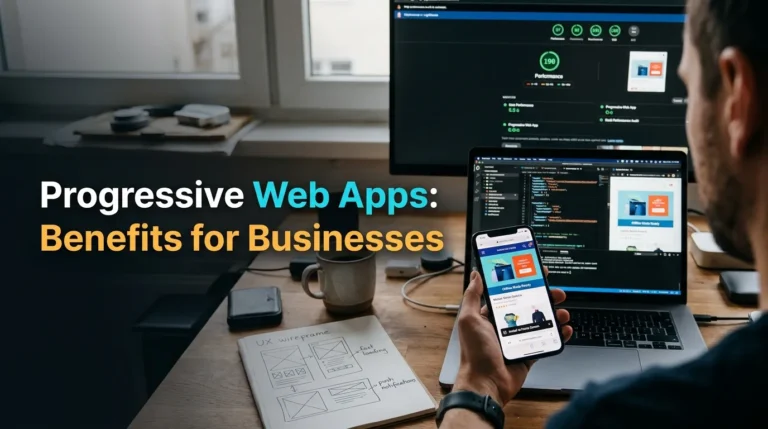
In the mobile-first economy, the gap between a desktop website, a mobile browser experience, and an installable native application determines whether a brand captures a sale or loses a customer to friction. For years, enterprises faced an expensive dilemma: invest heavily in bespoke native apps for iOS and Android, or rely on responsive websites that often felt clunky, suffered from network latency, and lacked push-notification capabilities.
Progressive Web Apps (PWAs) eliminate this compromise. By utilizing modern web capabilities—including service workers, web app manifests, and intelligent client-side caching—PWAs deliver an experience indistinguishable from a native mobile application directly through a standard web browser.
Whether you lead an e-commerce enterprise, a media outlet, a B2B SaaS platform, or a service marketplace, implementing a PWA can dramatically impact development expenditure, engagement metrics, search visibility, and bottom-line revenue.
What Is a Progressive Web App?
A Progressive Web App is a website built with standard technologies (HTML, CSS, JavaScript) that leverages progressive enhancement to provide native application features.
The architecture relies on three primary building blocks:
- Service Workers: Background JavaScript threads that intercept network requests, manage offline cache storage, handle background data sync, and deliver push notifications independently of active web page sessions.
- Web App Manifest: A lightweight JSON configuration file providing metadata (app name, icons, theme colors, display orientation, and start URL), allowing the device to treat the website as an installable application without an app store wrapper.
- Secure Protocol (HTTPS): Encryption that protects user data integrity, prevents man-in-the-middle attacks, and is mandatory for running service workers.
Together, these mechanisms allow users to add the application directly to their mobile or desktop home screen with a single tap, bypassing app stores altogether.
8 Transformative Business Benefits of PWAs
1. Drastic Reduction in Development and Maintenance Costs
Building native applications typically requires separate engineering teams: Swift/Objective-C specialists for iOS, Kotlin/Java developers for Android, and frontend engineers for the web. Each operating system requires its own codebase, testing cycles, feature backlogs, bug tracking, and release management.
A PWA operates on a single codebase. One responsive application serves mobile browsers, desktop environments (Windows, macOS, ChromeOS), and tablet devices alike. This unified approach delivers immediate business advantages:
- Lower engineering overhead: Teams build and test features once, cutting development timelines by 30% to 50%.
- No app store approval delays: Bug fixes and new features deploy instantly across all platforms via the web server, avoiding the review bottlenecks and release freezes imposed by Apple’s App Store and Google Play.
- Simplified maintenance: Infrastructure, analytics integrations, and security patches apply simultaneously across all channels.
2. Elimination of App Store Friction & High Commission Fees
Native app distribution introduces severe user drop-off points. To interact with a native app, a prospective customer must:
- Search the app store
- Authenticate their account
- Download a heavy file (often 50 MB to 200 MB+)
- Wait for installation
- Grant explicit device permissions before even viewing an item
Data shows that each additional step in an onboarding funnel degrades conversions by up to 20%. PWAs eliminate this friction completely. Users encounter your site through an organic search link, an ad, or a social post, and they immediately interact with the product. With an “Add to Home Screen” prompt, they install the app in under two seconds, consuming mere kilobytes or megabytes of storage.
Furthermore, bypassing native app ecosystems protects your profit margins by avoiding compulsory 15% to 30% in-app purchase commissions on digital goods and subscriptions, allowing you to use your preferred payment processors directly on the web.
3. Near-Instant Load Times and Caching Reliability
Speed directly impacts your revenue. Independent analytics repeatedly verify that every second of latency reduces mobile conversions by significant percentages.
PWAs address latency via pre-caching strategies managed by service workers. Essential static assets (app shells, fonts, UI frameworks, and primary assets) are cached during the user’s initial interaction. Upon return visits, the interface renders almost instantaneously, even before fresh dynamic data is pulled from the network.
| Metric Impact | Traditional Responsive Site | Progressive Web App |
| First Contentful Paint (FCP) | 2.5s – 4.5s | < 1.0s (Cached Shell) |
| Initial Download Size | 2MB – 5MB | Streamed progressively |
| Return Visit Latency | Network-dependent | Near-instantaneous |
| Memory Footprint | Browser tab dependent | < 5 MB installed storage |
4. Seamless Offline Usability & Flaky Network Resilience
In emerging markets or rural territories with 2G/3G connections, conventional websites fail entirely when coverage drops. PWAs shine in unstable network environments.
Through intelligent background caching, users can continue browsing catalogs, saving favorites, reading articles, and assembling shopping carts without an internet connection. When connectivity is restored, the service worker utilizes Background Sync APIs to transmit queued transactions, form submissions, or messages automatically without user intervention.
5. Increased Customer Retention via Web Push Notifications
Historically, re-engagement tools like push notifications were exclusive to native applications. Modern desktop and mobile browsers now support the Push API and Notification API.
Businesses can send relevant, opt-in alerts directly to a user’s lock screen or notification center, even when the browser is completely closed. This capability unlocks powerful marketing automation workflows:
- Abandoned cart reminders with customized discount codes.
- Real-time order fulfillment, dispatch, and delivery tracking.
- Breaking industry updates, flash sales, or personalized price drops.
- Subscription renewals and milestone alerts.
Because push notifications land directly on the device interface, click-through rates routinely outperform traditional email marketing campaigns by multiples.
6. Full Search Engine Discoverability (SEO)
Unlike native apps whose internal screens are trapped behind walled app store ecosystems, PWAs are indexed like standard web pages. Every URL within a PWA can be crawled, rendered, and ranked by Google, Bing, and other search engines.
Because Google heavily weights Core Web Vitals (Largest Contentful Paint, Cumulative Layout Shift, and Interaction to Next Paint), the high performance of a PWA directly elevates organic rankings. This allows businesses to capture top-of-funnel inbound search queries, direct visitors straight to optimized landing pages, and convert them seamlessly into loyal users.
7. Universal Shareability and Direct Linking
Every view in a well-structured PWA is accessible via a unique URL. This offers distinct viral and customer-support advantages:
- Customers can share exact product configurations or deep-linked articles via messaging apps, SMS, or social platforms with zero install friction for the recipient.
- Customer support teams can direct users to specific troubleshooting sections with single-click precision.
- Marketing attribution stays clean and trackable through standard UTM parameters.
8. Enhanced Security Standards
Security is non-negotiable for modern web enterprise operations. Because service workers have programmatic control over network traffic, the PWA specification mandates complete HTTPS encryption.
This guarantees:
- Protection against packet sniffing, malicious code injection, and data tampering.
- Compliance with standard enterprise payment gateways and consumer data privacy mandates (GDPR, CCPA).
- Reassurance to consumers through verified SSL certificates and browser privacy indicators.
Real-World Case Studies: Quantifying the ROI of PWAs
Global industry leaders have adopted PWAs with verifiable performance and commercial gains:
Flipkart (E-Commerce)
India’s largest e-commerce platform launched Flipkart Lite to tackle intermittent internet connectivity across Tier 2 and Tier 3 cities.
- 3x increase in user time spent on site.
- 40% higher re-engagement rate through push notifications.
- 70% greater conversion rate among consumers launching the app from the home screen.
- 3x reduction in data usage compared to their previous mobile experience.
Lancôme (Luxury Retail)
Luxury cosmetics brand Lancôme sought to lift lagging mobile conversion rates compared to desktop figures. Rebuilding their web footprint as a PWA delivered:
- 84% decrease in time until the page became fully interactive.
- 8% conversion rate directly attributed to re-engagement via push notifications.
- 17% overall increase in mobile revenue year-over-year.
Twitter Lite (Social Media)
To cater to users in regions with costly cellular data, Twitter built a progressive web app:
- 65% increase in pages viewed per session.
- 75% increase in Tweets sent.
- 20% reduction in bounce rates.
- Application size dropped under 600 KB, compared to over 100 MB for the native equivalent.
Technical Architecture: How a PWA Functions
                      +-----------------------------+
                      |       User Interface        |
                      |   (HTML / CSS / JavaScript) |
                      +--------------+--------------+
                                     |
                                     v
                      +-----------------------------+
                      |       Service Worker        |
                      |  (Network Interception &    |
                      |   Background Sync Engine)   |
                      +-------+--------------+------+
                              |              |
             Cache Hit        |              |  Cache Miss / API Call
       +----------------------+              +----------------------+
       |                                                            |
       v                                                            v
+-------------+                                            +----------------+
| Cache API / |                                            | Remote Server  |
| IndexedDB   |                                            | (REST/GraphQL) |
+-------------+                                            +----------------+
- User Request: The client triggers an action, such as tapping a page or requesting product details.
- Service Worker Interception: The service worker evaluates caching rules (e.g., Cache-First for static UI components, Network-First for dynamic pricing).
- Instant Resolution: If cached assets exist, they render instantaneously, providing a responsive experience even offline.
- Stale-While-Revalidate Update: Fresh assets fetch quietly in the background and update the cache for the subsequent session, eliminating loading spinners.
When Should a Business Choose a Native App Over a PWA?
While PWAs offer immense value, they are not universally optimal for every use case. Strategic decision-makers should evaluate specific device integration needs:
- Choose a PWA if: Your core business relies on inbound content discovery, e-commerce, transaction workflows, booking, media consumption, or enterprise SaaS dashboards where frictionless access and rapid updates drive user acquisition.
- Choose a Native App if: Your software requires deep access to low-level hardware—such as complex ARKit/ARCore augmented reality tracking, high-performance 3D gaming engines (Metal/Vulkan), Bluetooth peripherals, geofencing background beacons, or health sensors that require proprietary platform APIs.
Preparing Your Business for PWA Adoption
Transitioning to a Progressive Web App does not require discarding your entire existing tech stack. Most organizations adopt an iterative, phased rollout:
- Audit Performance Bottlenecks: Run Google Lighthouse diagnostics across your existing mobile web paths to establish baselines for speed, accessibility, and Core Web Vitals.
- Implement HTTPS and Web Manifest: Ensure your domain runs securely over SSL, configure your
manifest.json, and set your branding assets to enable home-screen installation. - Deploy Basic Service Workers: Begin with simple offline fallback pages and static asset caching, then progressively introduce advanced features like push notifications and background data synchronization.
- Monitor Business KPIs: Track changes in mobile bounce rates, session duration, cart completions, and return visitor frequency.
Summary
Progressive Web Apps offer a balanced intersection of web reach and native capability. By dismantling the barriers of app stores, reducing multi-platform development overhead, delivering near-instant speeds, and maintaining functionality across poor networks, PWAs convert casual visitors into repeat, loyal customers. For forward-thinking organizations, investing in a PWA is not merely an engineering update—it is a high-leverage growth strategy designed to capture greater market share in an increasingly competitive digital landscape.