
Walk into any convenience store, and the silver-and-blue slender can sits quietly behind refrigerated glass. It contains carbonated water, caffeine, taurine, B-group vitamins, and sugars. Objectively, it is a functional commodity in a crowded FMCG landscape. Yet, Red Bull commands unmatched brand equity and premium pricing across international markets.
The secret to this commercial dominance is a radical marketing philosophy: Red Bull rarely talks about its product.
Instead of highlighting taste, ingredient efficacy, or competitive cost, Red Bull inverted traditional brand advertising. Dietrich Mateschitz, the brand’s co-founder, realized early on that selling a carbonated stimulant was a race to the bottom against established soda conglomerates. His solution was profound: build a media publishing powerhouse that documents extreme sports, adventure, and high-octane human achievement, with a beverage company operating quietly in the background to monetize the attention.
Red Bull does not run campaigns to sell a beverage. It produces cultural capital that inspires identity, turning passive consumers into active believers of a philosophy encapsulated in five words: Red Bull Gives You Wings.
1. The Paradigm Shift: From Product Utility to Lifestyle Identity
Traditional marketing follows a standard promotional formula: demonstrate a problem, introduce the product as the solution, highlight key features, and deliver a call to action. In the energy drink category, conventional tactics emphasize alertness, focus, and physical stamina.
Red Bull abandoned this playbook entirely.
When you examine Red Bull’s core messaging, the product itself is practically invisible. You will rarely find an advertisement analyzing the micronutrients inside the can or making clinical claims about sustained energy release. Red Bull shifted its value proposition from product utility to lifestyle alignment.
Traditional Brand Model:
Product Engine  ──>  Marketing Department  ──>  Consumer Buys Utility

Red Bull Ecosystem Model:
Media House / Events  ──>  Audience Engagement  ──>  Lifestyle Affiliation  ──>  Consumer Buys Identity
By associating the brand with adrenaline, danger, peak human performance, and boundary-pushing ambition, Red Bull solved the fundamental challenge of commoditization. Consumers do not pay a premium for taurine; they pay for what holding that slender silver can signals about their personal identity, mindset, and aspirations.
2. Red Bull Media House: The Engine of an Attention Conglomerate
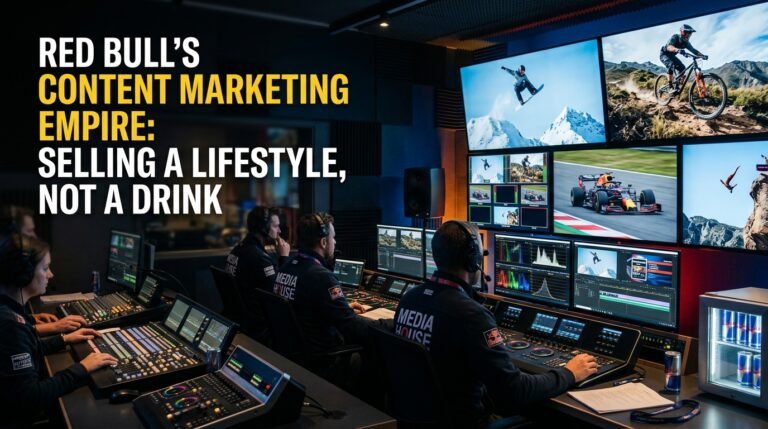
In 2007, Red Bull formalized its content strategy by launching Red Bull Media House in Salzburg, Austria. This was not an in-house advertising department designed to cut agency retainer fees. It was incorporated as a standalone, multi-platform media enterprise.
Red Bull Media House operates like a modern entertainment studio, producing:
- Full-length documentary films (The Art of Flight, Blood Road)
- High-circulation print publications (The Red Bulletin)
- Dedicated digital television and streaming apps (Red Bull TV)
- Music recording studios and creator academies
- Thousands of hours of ultra-high-definition action sports footage distributed across digital platforms
                     ┌───────────────────────────────┐
                     │     Red Bull Media House      │
                     └───────────────┬───────────────┘
          ┌──────────────────────────┼──────────────────────────┐
          ▼                          ▼                          ▼
  Proprietary IP              High-Impact Events        Long-Form Production
  • The Red Bulletin          • Red Bull Stratos        • The Art of Flight
  • Red Bull TV               • Red Bull Rampage        • Red Bull Records
  • Digital / Social Hubs     • Soapbox Race            • Original Documentaries
The critical business distinction between traditional corporate sponsors and Red Bull is ownership of Intellectual Property (IP).
When a traditional corporation sponsors an athletic competition, it pays an organizer millions of dollars to place logos on jerseys and sideline banners. When the tournament ends, the return on investment vanishes. Red Bull bypassed this dynamic by creating and owning its events outright. From the downhill cliff drops of Red Bull Rampage to the acrobatics of Red Bull Cliff Diving and the grass-roots humor of the Red Bull Soapbox Race, Red Bull controls the distribution rights, broadcast contracts, media production, and narrative framing.
The media division does not function merely as a cost center burning marketing capital; it creates content valuable enough that external television networks, streaming platforms, and print publishers license it directly.
3. The Pinnacle of Content Marketing: Red Bull Stratos
In October 2012, Red Bull orchestrated what remains the masterclass in content-first brand building: Red Bull Stratos.
Austrian skydiver Felix Baumgartner ascended into the stratosphere inside a helium balloon capsule, stepping out at 128,100 feet (over 39 kilometers above Earth) to break the sound barrier in freefall.
The execution was historic across both science and media:
- 8 million concurrent live viewers watched the jump on YouTube, shattering all previous live-stream records.
- Global news networks broadcast the event live, using Red Bull’s proprietary feed and carrying the iconic dual-bull logo to hundreds of millions of households.
- The broadcast generated an estimated tens of millions of dollars in earned media value within days.
Yet, throughout the multi-hour live broadcast, Baumgartner never cracked open a can of Red Bull. No voiceover urged the audience to visit a retailer. The event was presented strictly as an audacious scientific and human achievement. Red Bull demonstrated that it does not merely sponsor moments of human triumph—it engineers them.
4. The Athletic Ecosystem: Owning Teams, Not Just Jerseys
Beyond standalone events, Red Bull embedded its lifestyle marketing into the sporting world through structural ownership. Rather than signing conventional endorsement deals, Red Bull acquired, rebranded, and managed professional athletic franchises across global sports ecosystems:
| Sports Entity | Discipline | Strategic Role |
| Oracle Red Bull Racing & RB | Formula 1 | High-technology engineering, precision speed, global elite prestige |
| RB Leipzig / Red Bull Salzburg / NY Red Bulls | Professional Football (Soccer) | International youth development, high-tempo athletic philosophy |
| Red Bull KTM Factory Racing | MotoGP / Motocross | Raw mechanical power, extreme off-road endurance |
| Sponsored Athlete Roster (800+ Athletes) | Surfing, Climbing, Esports, B-Boying | Grassroots cultural credibility and continuous content generation |
When Oracle Red Bull Racing wins a Formula 1 Grand Prix, the team does not display a sponsor’s logo on an independent chassis—the team is Red Bull. The podium celebrations, the engineering debriefs, the mechanic uniforms, and the constructor trophies all feed directly into Red Bull’s broader brand equity.
By signing over 800 individual athletes across dozens of disciplines, Red Bull creates an inexhaustible stream of authentic visual stories. When slackliner Jaan Roose traverses a wire suspended between skyscrapers or freesurfer Carissa Moore carves towering waves, Red Bull’s camera crews capture the moment with cinema-grade optics. The athlete gets elite training facilities, performance medical staff, and financial security; Red Bull gets genuine, compelling stories that cannot be replicated in a studio.
5. Strategic Takeaways for Modern Brands
Few companies possess the multibillion-dollar budget required to field a Formula 1 constructor or drop a human being from the stratosphere. Nevertheless, the strategic pillars underpinning Red Bull’s empire offer actionable principles for modern businesses:
Audience-First Value Over Self-Congratulation
Most branded content fails because it obsesses over the product. Modern audiences possess sharp filters for corporate self-promotion and skip past standard ads within seconds. Red Bull succeeds because its content is inherently entertaining, visually breathtaking, or emotionally moving. If your media provides genuine entertainment or educational value, the audience will actively seek it out.
Own the Community’s Cultural Artifacts
Rather than paying rent on someone else’s platform or community, build assets that your target audience cherishes. Whether it is an authoritative industry podcast, a definitive annual benchmark report, or an open-source technical tool, owning the medium gives you compounding returns on audience trust.
Focus on Shared Identity
Products solve functional friction, but brands satisfy psychological needs. Determine what your audience aspires to be, the subcultures they belong to, and the values they champion. When your brand champions those exact ideals through authentic storytelling, you cease competing on price and begin operating on loyalty.
Red Bull’s core achievement was realizing that attention is the world’s scarcest commodity. By treating content not as a supporting tactic for a beverage, but treating the beverage as a monetization engine for a media empire, the brand built a fortress of cultural relevance. Long after conventional ad campaigns are forgotten, Red Bull remains the benchmark for what happens when a company stops interrupting what people care about and becomes what they love.