
Traditional fashion retail long adhered to a rigid, seasonal calendar. Brands designed garments six to nine months ahead of time, outsourced production to distant low-cost manufacturing hubs, and shipped immense inventories across oceans. If consumer demand deviated from designers’ initial forecasts, retailers were left holding piles of unsold stock—leading to deep discounts, compressed margins, and supply chain friction.
Inditex, the parent company of Zara founded by Amancio Ortega in Galicia, Spain, dismantled this traditional paradigm. Instead of attempting to predict what consumers would want three seasons in advance, Zara designed a responsive, pull-based supply chain built on real-time feedback, localized production clusters, and rapid distribution. While traditional apparel brands take up to six to nine months to transition a concept from the sketchbook to store hangers, Zara compresses that cycle into just two to three weeks.
This agility has turned Zara into a benchmark in operational research and supply chain engineering.
1. The Core Philosophy: Pull vs. Push Models
To understand Zara’s operational model, one must contrast the push model with the pull model.
The Traditional Push Model
Traditional retailers design seasonal lines based on trend projections. Once manufactured in large volumes, products are “pushed” down the supply chain into stores. Success hinges almost entirely on forecast accuracy:
- High forecast error: Long lead times amplify inaccuracies in demand estimation.
- Capital lock-in: Huge volumes of working capital remain trapped in warehouses and cargo holds.
- Heavy markdowns: Unsold inventory forces seasonal firesales, slashing operating margins.
Zara’s Responsive Pull Model
Zara operates an ultra-lean pull model. Production is triggered by direct customer demand and actual store-level performance:
- Micro-batches: Production runs are intentionally kept small.
- Market-driven adjustments: If a design sells rapidly, production scales within days; if a garment underperforms, production halts immediately.
- Margin preservation: Approximately 85% of Zara’s inventory sells at full retail price, compared to industry averages hovering between 60% and 70%.
2. Vertical Integration: Strategic Control Over the Value Chain
A foundational pillar of Zara’s speed is its degree of vertical integration. Rather than outsourcing manufacturing entirely to third-party offshore factories, Inditex maintains ownership or direct operational control over key stages of its value stream.
| Supply Chain Stage | Industry Standard (Offshore Push) | Zara’s Integrated Approach |
| Design Phase | 2–3 months per collection | 24–48 hours continuous cycle |
| Sourcing & Fabric | Pre-dyed fabrics ordered months ahead | Greige (undyed) fabric held in reserve |
| Manufacturing | 100% low-cost offshore (Asia) | Hybrid: ~50% nearshored, 50% offshore |
| Logistics / Hubs | Decentralized, multi-node maritime transit | Centralized automated hubs (Spain) |
| Lead Time | 6 to 9 months | 2 to 3 weeks |
By retaining in-house pattern-making, automated fabric cutting, and dyeing capabilities near its headquarters in Arteixo (La Coruña), Spain, Zara avoids the communication delays and production queues that stifle conventional supply networks.
3. The Dual-Sourcing Manufacturing Strategy
Zara does not completely reject offshore production. Instead, it balances speed and cost through an intentional dual-sourcing architecture:
Nearshoring for High-Fashion Agility (~50–60%)
For trend-sensitive, time-critical apparel—such as a blazer inspired by a weekend runway show or a viral social media silhouette—Zara produces locally in Spain, Portugal, Morocco, and Turkey.
- Production costs per unit are higher compared to East Asia, but the savings gained from eliminating markdown risk and transit latency offset the labor premium.
- Nearshore facilities can deliver finished garments to European logistics hubs via ground transportation within 24 to 48 hours.
Offshoring for Predictable Basics (~40–50%)
For standardized, price-sensitive garments with predictable demand curves—such as basic white tees, denim, and seasonal essentials—Zara utilizes manufacturing facilities in Asia (China, Bangladesh, Vietnam, India).
- These items do not require rapid design iteration.
- Holding long-lead basic inventory allows Zara to capture economies of scale without risking obsolete stock.
4. Fabric Postponement: Manufacturing Flexibility
A central concept in supply chain theory demonstrated by Zara is postponement—delaying the final form of a product until actual customer demand is known.
Fashion trends shift quickly in color, pattern, and silhouette, but fabric weaves remain comparatively stable. Inditex purchases vast volumes of raw, undyed cloth known as greige fabric through its subsidiaries (such as Comditel).
- Why it matters: Raw fabric is versatile. If emerald green suddenly trends mid-season, Zara does not need to source new textiles; it simply dyes its stored greige reserves in automated finishing facilities and cuts them into current patterns.
- Impact on speed: Greige fabric procurement cuts lead times from weeks down to days, insulating the brand from raw-material shortages while preserving working capital.
5. Information Flow: Real-Time Feedback Loops
Zara’s design team does not work in an isolated studio disconnected from the market. At its headquarters, over 300 designers, pattern-makers, and commercial buyers sit side-by-side in open-plan spaces, continuously analyzing performance data.
Store Managers as Frontline Analysts
Store managers play an active role in merchandise decisions. Equipped with specialized handheld terminals (PDAs), managers track:
- Real-time Point of Sale (POS) receipts.
- Customer inquiries (e.g., shoppers requesting a cropped version of an existing trench coat).
- Garment abandonment patterns from fitting rooms.
Rapid Prototyping
Every evening, store performance and customer feedback flow into Arteixo. Commercial teams evaluate this data alongside emerging cultural trends, digital metrics, and fashion week movements. If an insight gains traction, designers draft a pattern, sample cutters build a prototype down the hall, and production orders go out to nearby workshops within 48 hours.
6. The Centralized Logistics Engine: “The Cube”
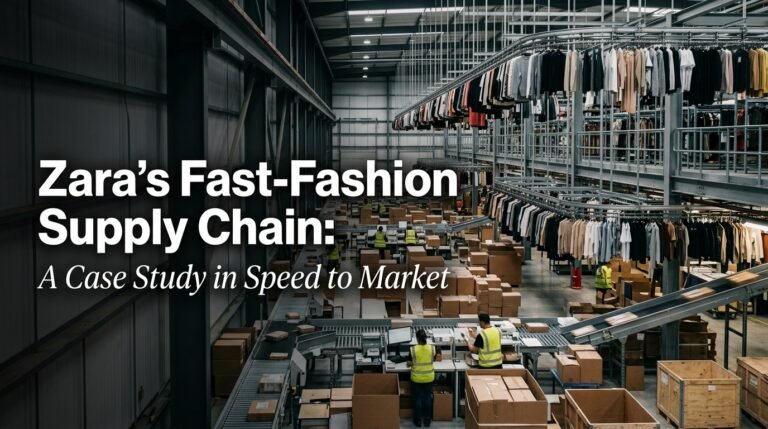
Logistics is the engine that converts Zara’s rapid manufacturing into commercial availability. Regardless of where an item is manufactured, almost all products funnel through Inditex’s centralized distribution hubs in Spain, anchored by facilities like Arteixo and Zaragoza.
Automation and Precision
Zara’s distribution centers feature extensive automated sorting lines, optical barcode readers, and subterranean monorail systems:
- Garments are tagged with RFID (Radio Frequency Identification) at the point of manufacture, enabling end-to-end tracking through packaging, distribution, and store receiving.
- Automated carousels sort millions of items weekly with minimal manual handling.
Cadence and Scarcity
Distribution follows a strict schedule:
- Every store worldwide receives fresh shipments twice a week on designated days.
- European stores receive shipments within 24 to 36 hours via dedicated trucking.
- Stores across the Americas and Asia receive merchandise via scheduled air freight within 48 hours.
This bi-weekly cadence creates an atmosphere of artificial scarcity. Shoppers know that inventory turns over rapidly and that popular garments sell out quickly without replenishment. This dynamic drives store foot traffic, reduces purchase hesitation, and reinforces full-price purchases.
7. Strategic Trade-Offs and Vulnerabilities
Zara’s supply chain model provides notable speed advantages, but it also carries distinct structural trade-offs:
- Higher Freight and Energy Expenses: Relying on scheduled air freight for international distribution and regional road fleets creates higher transportation costs per garment compared to container ship transit.
- Geopolitical and Labor Exposure: Nearshoring clusters in Southern Europe, North Africa, and the Middle East expose Inditex to localized wage inflation, regulatory shifts, and regional trade disruptions.
- Sustainability Pressures: Ultra-responsive fast-fashion models face growing scrutiny over environmental impact, material waste, and the consumption patterns driven by frequent product turnarounds. In response, Inditex has invested heavily in recycled textile initiatives, supply chain transparency, and circular fabric programs.
Key Takeaways for Modern Supply Chains
Zara proved that in volatile consumer markets, speed and responsiveness often outperform scale and low unit costs. By pairing vertical control and dual-sourcing with postponement strategies and real-time market data, Inditex turned logistics from a routine back-office function into a central competitive advantage.