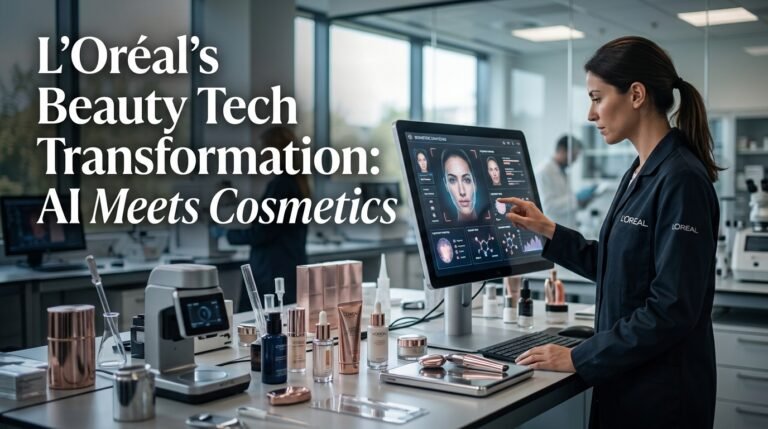
For over a century, the cosmetics industry was built on a straightforward formula: chemical formulation, elegant packaging, seasonal advertising campaigns, and department store counters. Today, that playbook is no longer enough. The global consumer now expects hyper-personalization, immediate feedback, and precision efficacy. At the forefront of this shift is L’Oréal Groupe, the world’s largest beauty conglomerate.
Rather than treating digital tools as auxiliary marketing novelties, L’Oréal has undertaken an ambitious structural overhaul to redefine itself not merely as a cosmetics brand, but as a digital-first “Beauty Tech” enterprise. By converging artificial intelligence, computer vision, augmented reality (AR), and biotechnology, the French cosmetics giant is transforming how products are conceived, formulated, manufactured, and personalized for consumers across the globe.
1. The Strategic Catalyst: From CPG Titan to Beauty Tech Leader
Historically, consumer packaged goods (CPG) companies relied on aggregate demographics: age brackets, geographical regions, and broad skin categorizations. However, the modern beauty consumer represents a market of one. Skin is a living, dynamic organ affected by sleep, pollution, ultraviolet exposure, hormonal fluctuations, and genetic traits.
L’Oréal realized early that static formulations delivered through generic retail channels created friction. Customers routinely purchased shades that failed to match in natural light or bought multi-step skincare routines unsuited to their skin barriers. The solution lay in closing the gap between chemistry and personal data.
By declaring its ambition to become the world’s champion of Beauty Tech, L’Oréal integrated software engineers, data scientists, and UX designers directly into its core research and development (R&D) and commercial teams. The goal was twofold: dismantle the guesswork in product selection and accelerate the pipeline of product discovery.
2. Modiface and Computer Vision: The AR Testing Ground
A pivotal turning point in this strategy came in 2018 with L’Oréal’s acquisition of ModiFace, a Toronto-based pioneer in augmented reality and artificial intelligence applied to the beauty industry. Unlike standard acquisitions where software is integrated via license, L’Oréal brought ModiFace’s proprietary computer vision engines entirely in-house.
Virtual Try-On (VTO)
Using facial recognition and tracking algorithms, ModiFace maps dozens of facial landmarks in real time. The software accounts for ambient lighting, skin texture, and underlying undertones to simulate how a pigment—such as an Yves Saint Laurent lipstick, a Maybelline mascara, or an Armani foundation—will appear under natural or fluorescent light.
This technology serves more than an aesthetic purpose; it drives direct commercial performance. Virtual try-ons decrease return rates, increase session durations, and significantly lift e-commerce conversion rates compared to traditional static imagery.
Inclusive Diagnostics
One common limitation of early digital color-matching tools was algorithmic bias—frequently failing on deeper skin tones or varied lighting environments. L’Oréal tackled this by training deep neural networks across hundreds of thousands of dermatologically verified photographic data points spanning all phototypes on the Fitzpatrick scale. This dataset gave rise to consumer diagnostic platforms like SkinConsult AI and Skin Genius, enabling smartphone cameras to detect signs of aging, dehydration, hyperpigmentation, and pore structure with dermatologist-level consistency.
3. Generative AI and Conversational Beauty: The Era of “Beauty Genius”
As large language models (LLMs) and multi-modal generative AI systems matured, L’Oréal evolved from static diagnostic apps to conversational, real-time consultation assistants.
The introduction of L’Oréal Paris Beauty Genius exemplifies this step forward. Serving as an interactive personal beauty advisor, Beauty Genius integrates:
- Natural Language Understanding: Allowing users to articulate qualitative concerns (e.g., “My skin feels tight after cleansing and my foundation looks flaky by 2 PM”).
- Multi-Modal Diagnostic Analysis: Merging self-reported lifestyle habits with real-time selfie skin scans.
- Contextual Product Recommendations: Sifting through thousands of active ingredient profiles across L’Oréal’s portfolio to suggest tailored routines that minimize ingredient conflicts.
Crucially, this AI model is trained on proprietary dermatological literature, clinical trials, and formulation data rather than unvetted public internet advice, ensuring safety, brand integrity, and scientific accuracy.
4. Hardware Meets Formulation: The Rise of At-Home Customization
L’Oréal’s AI roadmap extends beyond smartphone screens into physical, connected hardware devices. Recognizing that a person’s skin changes with seasons, travel, and environmental stressors, the company pioneered smart dispensing devices:
- Perso & Rouge Sur Mesure (YSL Beauty): Powered by an AI algorithm, these devices leverage motorized cartridges to custom-blend personalized liquid lipstick shades or skincare serums on demand. Consumers can upload a photo of an outfit to generate an exact color-matched lip pigment in seconds.
- Colorsonic: A handheld smart device engineered to automate at-home hair coloration. Colorsonic mixes and dispenses formula via oscillating bristles, ensuring uniform coverage while minimizing mess and chemical waste.
- HAPTA: Developed for individuals with limited hand and arm mobility, HAPTA integrates motorized stabilization and smart motion controls, allowing users with tremors or restricted fine motor skills to steadily apply lipstick and mascara. This demonstrates how assistive robotics and AI algorithms can make beauty accessible to underserved demographics.
5. Behind the Counter: R&D and Sustainable Green Sciences
While consumer-facing gadgets capture headlines, some of L’Oréal’s most consequential AI applications operate out of view inside research laboratories and supply chains.
Molecular Modeling & Formulation
Formulating cosmetics is an intricate balancing act between emulsion stability, preservation, sensory texture, skin absorption, and safety. L’Oréal researchers employ machine learning to simulate molecular interactions and predict how active ingredients behave together. This predictive modeling slashes product development timelines from years to months, reducing the reliance on traditional physical trial-and-error chemistry.
The “Green Sciences” Pivot
Under its sustainability commitments (L’Oréal for the Future), the group targets sustainable, bio-based sourcing for the vast majority of its ingredients. AI assists green chemistry by optimizing fermentation processes, identifying renewable botanical alternatives to petroleum-derived polymers, and tracking life-cycle assessments across supply networks to curb water and carbon footprints.
6. Navigating the Challenges: Data Privacy, Bias, and Skepticism
The rapid digitization of cosmetics is not without hurdles. The collection of granular biometric and facial data places L’Oréal under scrutiny regarding privacy legislation such as the European Union’s GDPR and various biometric privacy statutes worldwide.
To maintain consumer trust, L’Oréal emphasizes privacy-by-design architectures:
- Edge Processing: Many image scans are processed locally on the user’s mobile device and discarded immediately rather than stored on centralized servers.
- Algorithmic Auditing: Continual fine-tuning to prevent algorithmic drift and ensure consistent accuracy across all ethnicities, ages, and genders.
- Transparency in Claims: Clear labeling distinguishing between cosmetic improvements and clinical medical treatments, ensuring AI diagnostic tools do not overpromise therapeutic outcomes.
The Verdict: Redefining the Modern Beauty Paradigm
L’Oréal’s transformation proves that legacy brands do not have to fall behind nimble digital startups. By betting early on artificial intelligence, acquiring complementary tech companies, and investing heavily in internal digital literacy, L’Oréal has turned physical cosmetics into a data-driven service ecosystem.
Beauty is no longer confined to a jar or compact. In the modern era, beauty is a synergy of biology, chemistry, and algorithmic intelligence—and L’Oréal’s Beauty Tech transformation has firmly cemented its position as the architect of that future.