
The Seven-Line Revolution: Inside Stripe’s Developer-First Growth Strategy

In the late 2000s, adding payment processing to a web application was a slow, bureaucratic slog. Founders had to negotiate merchant accounts with legacy banks, wait weeks for underwriting approvals, submit physical paperwork, and battle Byzantine gateway architectures. When brothers Patrick and John Collison founded Stripe in 2010, they rejected the standard enterprise sales playbook. […]
HubSpot’s Inbound Marketing Blueprint: Building an Industry Category

In the mid-2000s, commercial software marketing ran into a brick wall. Cold calls were screened by caller ID, spam filters routed unsolicited sales emails straight to the trash, and banner ads had devolved into visual noise that internet users actively tuned out. The traditional marketing playbook—relentlessly interrupting buyers until they relented—was breaking down. Instead of […]
Salesforce and the SaaS Revolution: A Case Study in Enterprise Growth

In 1999, deploying enterprise software was synonymous with multi-million-dollar capital outlays, server rooms running hot with on-premise hardware, and consulting teams executing eighteen-month rollout cycles. Giants like Siebel Systems, SAP, and Oracle dictated corporate information technology. Into this rigid marketplace stepped Marc Benioff and his co-founders, operating out of a rented San Francisco apartment with […]
Shopify’s Rise: Powering the Independent Merchant Economy

When Tobias Lütke, Daniel Weinand, and Scott Lake set out to sell snowboards online under the name Snowdevil in 2004, they ran into a roadblock that defined early Web 2.0: existing e-commerce software was clunky, rigid, and prohibitively expensive. Rather than compromise on a sluggish online catalog, Lütke—a software engineer—built custom software on Ruby on […]
Red Bull’s Content Marketing Empire: Selling a Lifestyle, Not a Drink
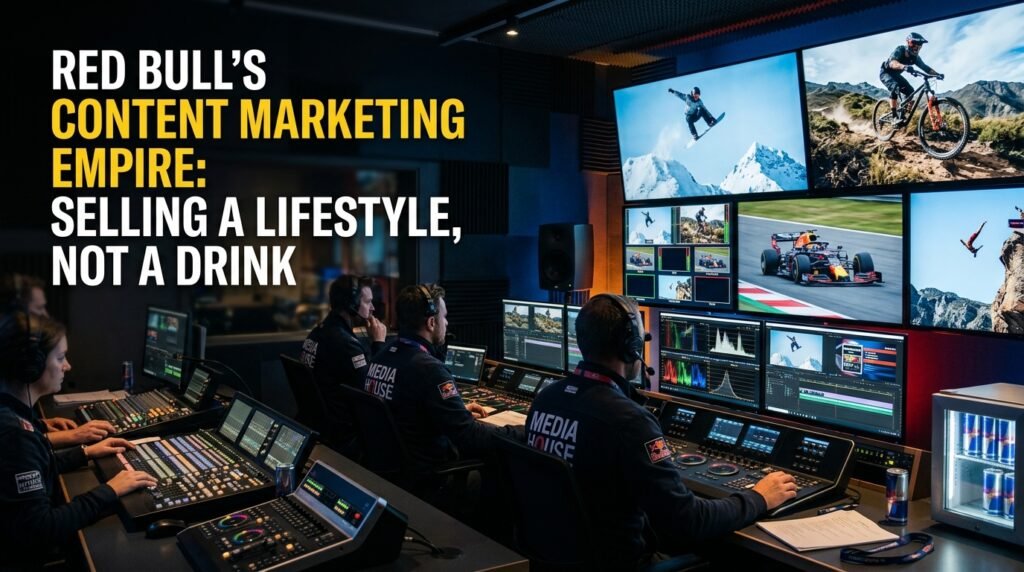
Walk into any convenience store, and the silver-and-blue slender can sits quietly behind refrigerated glass. It contains carbonated water, caffeine, taurine, B-group vitamins, and sugars. Objectively, it is a functional commodity in a crowded FMCG landscape. Yet, Red Bull commands unmatched brand equity and premium pricing across international markets. The secret to this commercial dominance […]
Zara’s Fast-Fashion Supply Chain: A Case Study in Speed to Market

Traditional fashion retail long adhered to a rigid, seasonal calendar. Brands designed garments six to nine months ahead of time, outsourced production to distant low-cost manufacturing hubs, and shipped immense inventories across oceans. If consumer demand deviated from designers’ initial forecasts, retailers were left holding piles of unsold stock—leading to deep discounts, compressed margins, and […]
Starbucks’ Third-Place Strategy: Branding Beyond the Coffee Cup

When Howard Schultz walked the cobblestone streets of Milan in 1983, he experienced an epiphany that would fundamentally reorder global retail. The Italian espresso bar was not merely a dispensary for dark roast caffeine; it was an extension of civic life. Patrons lingered at marble counters, baristas addressed regulars by name, and neighborhoods found their […]
Airbnb’s Trust Economy: How a Platform Built Billion-Dollar Confidence

In 2007, when Brian Chesky and Joe Gebbia inflated three air mattresses on the floor of their San Francisco apartment to help pay rent, the premise was widely regarded by venture capitalists as untenable. Convincing ordinary people to open their private bedrooms to unvetted strangers—and convincing travelers to bypass established hotel chains to sleep in […]
Spotify’s Growth Playbook: How Data, Personalization, and Market Expansion Built an Audio Empire

In 2006, the recorded music industry faced an existential threat: rampant digital piracy. Platforms like Napster, LimeWire, and BitTorrent had conditioned millions of consumers to expect immediate, free access to the world’s music. Traditional record labels responded with lawsuits, digital rights management (DRM) restrictions, and punitive pricing. Daniel Ek and Martin Lorentzon saw a different […]
Netflix’s Content Strategy: A Case Study in Global Streaming Dominance

When Netflix mailed its first red DVD envelope in 1998, it operated as an agile logistics challenger to brick-and-mortar rental stores. Today, with over 300 million paid memberships spanning more than 190 countries, Netflix is an omnipresent media empire. The company did not achieve this scale merely by transitioning from postal deliveries to digital distribution; […]